European Economic
and Social Committee
European Economic
and Social Committee
The European Economic and Social Committee (EESC) is the voice of organised civil society in Europe.
Find out more about its role and structure at http://www.eesc.europa.eu/en/about
The EESC issues between 160 and 190 opinions, evaluation and information reports a year.
It also organises several annual initiatives and events with a focus on civil society and citizens’ participation such as the Civil Society Prize, the Civil Society Days, the Your Europe, Your Say youth plenary and the ECI Day.
Find the latest EESC opinions and publications at http://www.eesc.europa.eu/en/our-work/opinions-information-reports/opinions and http://www.eesc.europa.eu/en/our-work/publications-other-work/publications respectively.
The EESC is active in a wide range of areas, from social affairs to economy, energy and sustainability.
Learn more about our policy areas and policy highlights at http://www.eesc.europa.eu/en/policies
The EESC holds nine plenary sessions per year. It also organises many conferences, public hearings and high-level debates related to its work.
Find out more about our upcoming events at http://www.eesc.europa.eu/en/agenda/our-events/upcoming-events
Here you can find news and information about the EESC'swork, including its social media accounts, the EESC Info newsletter, photo galleries and videos.
Read the latest EESC news http://www.eesc.europa.eu/en/news-media/news and press releases http://www.eesc.europa.eu/en/news-media/press-releases
The EESC brings together representatives from all areas of organised civil society, who give their independent advice on EU policies and legislation. The EESC's326 Members are organised into three groups: Employers, Workers and Various Interests.
Find out more about our Members and groups at http://www.eesc.europa.eu/en/members-groups
The EESC has six sections, specialising in concrete topics of relevance to the citizens of the European Union, ranging from social to economic affairs, energy, environment, external relations or the internal market.
Find out more at http://www.eesc.europa.eu/en/sections-other-bodies
Der Europäische Wirtschafts- und Sozialausschuss (EWSA) begrüßt, dass 2022 zum Europäischen Jahr der Jugend ausgerufen wurde. Dies muss jedoch über bloße PR-Kampagnen hinausgehen, indem mit klaren Plänen zur EU-Jugendstrategie beigetragen und sichergestellt wird, dass dieses Jahr zu greifbaren Ergebnissen für alle jungen Europäerinnen und Europäer führt.
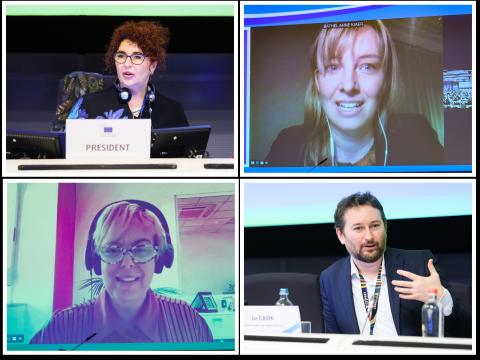
Auf der Januar-Plenartagung des EWSA stand eine Debatte über das Europäische Jahr der Jugend 2022 auf dem Programm, an der Anne Kjær Bathel, Vertreterin des Programms European Young Leaders, der Generalsekretär des Europäischen Jugendforums Joe Elborn und die Vorsitzende des Europäischen Lenkungsausschusses Jugend des Europarates Miriam Teuma teilnahmen.
„Junge Menschen müssen heute und in Zukunft bei der Gestaltung der Politik mitreden können“, so EWSA-Präsidentin Christa Schweng. „Weil sie die Zukunft sind, müssen wir sie unbedingt einbeziehen und in sie investieren, um den Aufbau stabiler, friedlicher und nachhaltiger Gesellschaften und die Entwicklung einer Politik zu fördern, die den spezifischen Bedürfnissen der jüngeren Generationen gerecht wird.“
Der EWSA ist in einer idealen Position, um mit Jugendnetzwerken zusammenzuarbeiten und Kontakte zu knüpfen, und er kann und will eine führende Rolle im Europäischen Jahr der Jugend übernehmen. Hierfür stützt er sich auf seine erfolgreichen Initiativen wie „Your Europe, Your Say!“, die Jugend-Klima- und -Nachhaltigkeitsdebatten und seinen EU-Jugendklimagipfel im Frühsommer.
Der EWSA freut sich auf seine konstruktive Mitwirkung am Europäischen Jahr der Jugend 2022. Das Jahr muss zu greifbaren Ergebnissen für die jungen Menschen in Europa führen, in den Politikbereichen, die für sie relevant sind. (ks)