
European Economic
and Social Committee
Fighting homelessness requires a holistic approach and collective action
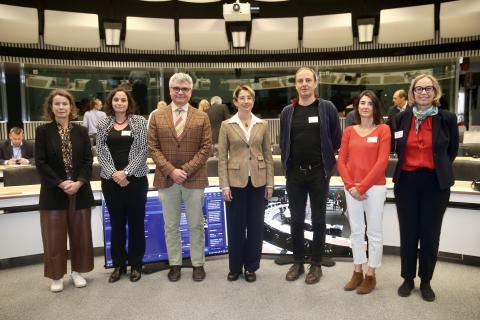
On 7 October, the European Economic and Social Committee (EESC) held a conference on homelessness and ways of eradicating it by 2030 through the principle of 'housing first' and a plethora of different support measures for people without permanent homes. Jointly organised with the European Federation of National Organisations Working with the Homeless (FEANTSA), the conference brought together European institutions, civil society representatives and experts, as well as people who had directly experienced homelessness.
Four in 100 Europeans have been homeless at least once in their lifetime and the number of homeless people has risen by a staggering 70% in the last decade. Now standing at an estimated 700 000, that number is expected to climb further due to the turbulent geopolitical situation and the subsequent increase in energy costs and in the cost of living more generally.
Although the political momentum for acting on homelessness is favourable, with many Member States coming up with national strategies on the subject, and with the recent launch of the European Platform on Combating Homelessness, it emerged from the conference that the growing problem of homelessness has not been properly addressed at European or national level.
Affordable, adequate social housing is the first prerequisite for getting homeless people off the streets and securing a roof over their heads, but many other support measures are needed to enable their full reintegration into society. These include quality jobs, education, psychosocial and peer support. This will require collective action at all levels of society.
EESC President Christa Schweng said that the EESC had already called on the Commission to launch a European action plan on housing, which would help Member States, regions and cities in Europe to sustainably boost the supply of social and affordable housing and effectively combat homelessness.
The role of civil society organisations, and particularly consumer organisations, local communities and actors on the ground, is key to promoting an affordable housing policy. We, the EESC, remain committed to the objective of a Union free from poverty and social exclusion. As set out in the European Pillar of Social Rights Action Plan, we need to do everything we can to reduce the number of people at risk of poverty or exclusion by at least 15 million (…) by 2030,
the EESC President said, opening the conference.
Homelessness is an issue of growing concern. There is something happening at the bottom of society which is worrisome. Current costs of living will push the number of homeless people up further, and we are expecting this number to be already higher than in 2019. For example, in Germany alone, at least 200 000 people are now in shelters or on the streets,
said the Director of the European Federation of National Organisations Working with the Homeless (FEANTSA), Freek Spinnewijn.
However, homelessness has not yet been mainstreamed in all relevant EU strategies. Although featuring in the strategy on Roma and in the disability strategy, it has not yet found its place in the Gender Equality strategy, the Youth Strategy or the Migration Pact, despite the fact that women, youth and migrants are more at risk of losing their homes or of not having a roof over their heads in the first place.
Michele Calandrino of the European Commission said that the European Platform on Combating Homelessness, in which the EESC is also playing an active part, is a shared enterprise, an innovative process in the area of governance at European level, of which one of the key themes is prevention. It will aim to eradicate homelessness by 2030 through people-centred housing policies, which aim at reducing evictions and offering emergency accommodation to people discharged from institutions. We fear there will be a drastic increase in homelessness. We need to make sure we have effective emergency protection for people on the streets,
Mr Calandrino said.
However, according to Yves Leterme, Chair of the European Platform on Combating Homelessness, we should keep in mind that people on the streets are just the visible part of the problem
. We should not just look at rooflessness, but also at other housing problems, such as co-sleeping or couch surfing. Inclusive labour and housing policy should take into account this continuum and the diversity of homelessness.
The issue of housing was also highlighted by Zdislava Odstrčilová, Czech Labour and Social Affairs Deputy Minister, who stressed that the housing crisis hitting her country was an EU-wide issue which must be addressed with EU-wide solutions.
Our ultimate goal should be to end rather than manage homelessness, and guarantee adequate housing and support services rather than offering only temporary accommodation. Our policies should be guided by the principle of "housing first" and focus on providing stable housing before addressing other issues. We need an ambitious EU strategy on the right to housing, in line with the legislative and policy framework in place at international and EU level,
concluded Laurenţiu Plosceanu, President of the EESC's Section on Employment, Social Affairs and Citizenship, which organised the conference.
Recommended for you
Energi – EESK varnar för nya beroendeförhållanden
News
Europeiska ekonomiska och sociala kommittén (EESK) intar en fast hållning i energifrågan i ett yttrande som antogs vid dess plenarsession i september: kommissionens förslag är ett steg i rätt…
Svenska rådsordförandeskapet 2023: Ukraina står fortfarande högst upp på dagordningen
News
Vid Europeiska ekonomiska och sociala kommitténs (EESK) plenarsession i januari hölls en debatt under vilken Sveriges EU-minister Jessika Roswall redogjorde för prioriteringarna för det nya…
Ditt Europa, din mening! 2023: Ungdomar efterlyser ett mer transparent, digitalt och förenklat EU
News
Den 23–24 mars stod Europeiska ekonomiska och sociala kommittén (EESK) för 14:e gången värd för ”Ditt Europa, din mening!” (YEYS!) i Bryssel, med 105 elever från 35 skolor från alla 27 EU-länder och…
EESK diskuterar agendan för det svenska EU-ordförandeskapet 2023
News
Vid sammanträdet i Europeiska ekonomiska och sociala kommittén (EESK) i Stockholm redogjorde Sveriges statssekreterare med ansvar för EU-frågor, Christian Danielsson, för den politiska inriktningen…
EU–Ukraina: driftskompatibilitet och solidaritet – nyckelfaktorer för transportförbindelserna
News
Vid en debatt som Europeiska ekonomiska och sociala kommittén (EESK) höll i Bryssel framhöll deltagarna vikten av infrastruktur och harmoniserade standarder för att sammanlänka EU med dess…