
European Economic
and Social Committee
EESC continues to push for a solution to Europe’s housing crisis
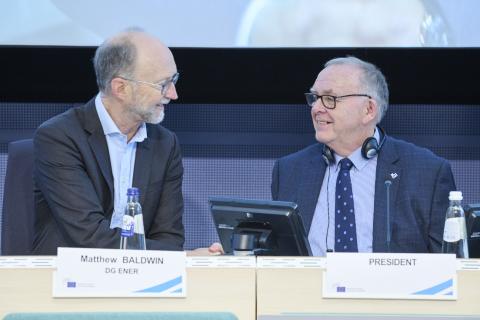
Following the presentation of the European Affordable Housing Plan by the European Commission last December, the European Economic and Social Committee (EESC) has gathered together all relevant stakeholders at European, national and local level to take stock of the ongoing housing emergency and discuss the way ahead. The Committee aims to tackle speculation, address investment gaps and make sure businesses remain competitive.
The EESC continues to shine a spotlight on the housing crisis and is ready to offer fresh recommendations on what can now be defined as a genuine emergency specifically impacting young people and the most vulnerable in our societies.
‘Housing is first and foremost a social issue,’ said EESC President Séamus Boland, ‘but it is no longer only that. It is an economic issue. A demographic issue. A competitiveness issue. This is why tackling the housing crisis is one of the key priorities of my mandate.’ Mr Boland also pointed out that in some Member States house prices and rents had gone up by more than 100% and that young Europeans were postponing becoming independent.
In his opinion, ‘the reality is unfortunately harsh: Europe is facing a housing emergency. An estimated 1.28 million people in Europe live on the street, in shelters or in temporary accommodation. In Brussels alone – the capital that should embody our collective European project – nearly 10 000 people are experiencing homelessness.’
Dan Jørgensen, European Commissioner for Energy and Housing, thanked the EESC for its work and for adopting the opinion For a European Affordable Housing Plan – the contribution of civil society in September 2025, ‘which was instrumental in helping us to shape our final plan.’ He added: ‘Now that we have our final plan, we must put it into action. We must harness all of the political tools and proposals so that we can support Member States, regions and local authorities to deliver more affordable, sustainable and quality housing.’
Mr Jørgensen listed the Commission’s next steps:
- delivering the Affordable Housing Act as soon as possible;
- continuing to work on a housing simplification package;
- focusing on financing – another cornerstone of the plan – and launching the pan-European Investment Platform later this year;
- stepping up work with Member States to assist young people and students, especially those from disadvantaged backgrounds;
- providing an extra political push and enabling closer high-level cooperation by launching a housing alliance and organising a housing summit this year.
The housing emergency requires immediate action
On this point, Matthew Baldwin, Deputy Director-General of the European Commission’s DG ENER and leader of the Commission’s Housing Task Force, echoed the Commissioner, stressing that it was important to keep political momentum because if housing was an issue for Europeans, then it had to be an issue for Europe.
Along the same lines, Aodhán Ó Ríordáin MEP, shadow rapporteur for the Anti-Poverty Strategy and the Housing Report, reiterated that housing and poverty were two sides of the same coin and that EU measures must be fully coordinated. He added that the Union needed a strong, urgent and collective effort from its institutions, Member States, local authorities, the social partners and civil society to deliver real change on the ground.
Michaela Kauer, Director of the Brussels office of the City of Vienna and coordinator of the EU Urban Agenda Housing Partnership, stressed that Vienna had been in the lead in promoting the concept of ‘housing for the common good’, for people and the planet. She explained that what made the Vienna model so successful was a strong political will to shape the housing market, not just to repair it, and the fact of constantly engaging with all actors involved. She also mentioned the need to address housing affordability through a gender lens because ‘energy poverty clearly has a woman’s face.’
For her part, Marie Linder, President of the International Union of Tenants (IUT) and of the Swedish Tenants’ Union, underlined the importance of having tenants’ representatives at the decision-making table and said that the focus must be kept on people by using tools such as rent stabilisation mechanisms, protection for long-term rental contracts and cost-neutrality for housing renovation.
Finally, Chiara Martinelli, Director of Climate Action Network Europe, said that the housing emergency went hand in hand with energy poverty and that it was important to push further and move from words to action and implement policies, turning the Commission’s plan into a shared EU priority.
The ongoing EESC opinion will set out recommendations
The EESC will put forward specific recommendations at the March plenary session when it adopts the opinion Tackling housing scarcity through affordable, sustainable and family-oriented housing policies, which is currently being drafted by rapporteur Thomas Kattnig. Speaking on behalf of the EESC’s Workers’ Group, Mr Kattnig highlighted: ‘The housing crisis requires a correct policy response and it is crucial that we look at the rent logic and prioritise social and limited profit housing. We need to tackle speculation, address investment gaps and ensure local and regional administrations have the tools to make decisions. It is time to make affordable housing a reality, not a privilege, and that means having social housing available on a mandatory basis.’
In the margins of the plenary, Cillian Lohan, President of the EESC’s Civil Society Organisations’ Group, emphasised that his group had long been consistently advocating for the housing crisis to be addressed and it therefore fully supported the European Affordable Housing Plan. As a result, he underlined the importance of the EESC’s participation in the first-ever EU Summit of Heads of State and Government, from which the European Housing Alliance is expected to emerge later this year.
Sandra Parthie, the EESC Employers’ Group President, emphasised EU competitiveness and said that affordable housing was not only a social concern, but an economic threat: ‘High housing costs are pushing workers out of some areas, creating barriers to employment and worsening labour shortages. Businesses are ready to be part of the solution, but construction costs, material shortages, lengthy permitting procedures and financing conditions are a challenge. We need more commitment from the EU and Member States.’
Work organisation
Downloads
-
EESC continues to push for a solution to Europe’s housing crisis