
European Economic
and Social Committee
Establishing the 28th Regime in Europe: EESC Employers' Group presents new study

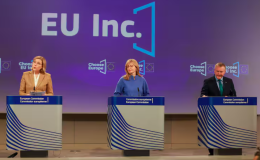
27 November 2025 – The EESC Employers' Group presented today a new study, "Establishing the 28th Regime in Europe: A Unified Legal Framework to Support Growth and Business", in the presence of Ana Gallego Torres, Director-General of DG Justice and Consumers, European Commission.
The Single Market is the European Union’s greatest economic asset, yet today it remains fragmented by a patchwork of 27 national corporate laws, tax codes, accounting rules, and labour systems. For businesses operating across borders, this legal maze acts as invisible tariffs on up to 45% on goods and over 100% on services. Expanding across borders still means paying lawyers and accountants, not hiring engineers or sales teams.
The 28th regime, to be presented by the EU Commission at the end of March, aims to offer a unified legal framework operating alongside the legal systems of EU Member States, but its implementation raises important concerns.
"Our study recommends a more disciplined framework based on a simple test to determine whether a proposed initiative truly qualifies as a 28th regime", explained Sandra Parthie, President of the EESC Employers' Group. "The 28th regime should be voluntary for businesses, mandatory for Member States to offer, and carefully designed to avoid overlapping with areas already regulated at EU level", she added.
However, making it optional is not enough. Companies must see practical benefits, such as lower costs, faster registration, and easier access to markets, before they sign up.
"The study calls for a layered roll-out starting where economic returns are greatest, for example corporate law", stressed Antonio García del Riego, member of the EESC Employers' Group. "The first layer would provide a unified EU incorporation and governance framework. A second layer would introduce tax coordination tools, while a third would simplify reporting through a European Accounting Board working with national authorities. Later stages—such as insolvency or labour law—would follow only after success is proven."
As Ana Gallego Torres, Director-General of DG Justice and Consumers in the European Commission, further underlined, the 28th regime should offer an open system, focusing on start-ups and scale-ups, but allowing all companies to grow even if they change status.
Europe has long debated how to reconcile diversity and unity. The 28th Regime, if carefully designed and implemented, could do precisely that, not through imposing harmonisation, but through voluntary alignment. It would preserve national sovereignty while granting ambitious companies the freedom to think and act on a continental scale.
Europe cannot afford another decade of fragmentation disguised as integration, it is time to finish what it started. The EESC Employers' Group will keep engaging with other stakeholders to make the 28th Regime an implementable tool.
For more information, please contact:
Daniela Vincenti, Communication Adviser
daniela.vincenti@eesc.europa.eu
+32 497 412095
Work organisation
Related content

Recommended for you
YEYS! 2023: Mládež žiada transparentnejšiu, digitálnejšiu a jednoduchšiu EÚ
News
Európsky hospodársky a sociálny výbor (EHSV) usporiadal 23. a 24. marca 14. ročník podujatia Vaša Európa, váš názor (YEYS), ktoré priviedlo do Bruselu 105…
Slovenská organizácia Integra získava Cenu EHSV pre občiansku spoločnosť za boj proti stereotypom spájaným s duševnými poruchami
News
Európsky hospodársky a sociálny výbor (EHSV) sa tohto roku rozhodol udeliť Cenu pre občiansku spoločnosť projektom na podporu duševného zdravia. Víťazom sa stala írska charitatívna organizácia…
EHSV otvára nový ročník Ceny pre občiansku spoločnosť, ktorej ústrednou témou je duševné zdravie
News
Organizácie občianskej spoločnosti, jednotlivci a súkromné spoločnosti môžu odteraz predkladať svoje neziskové projekty a uchádzať sa o cenu EHSV venovanú podpore duševnej pohody…
Odovzdajte svoj hlas v európskych voľbách v júni 2024: EHSV vyzýva Európanov, aby hlasovali za zjednotenú a demokratickú Európu
News
Vzhľadom na celosvetový trend ústupu demokracie, rýchle šírenie dezinformácií a zvyšujúcu sa nespokojnosť v dôsledku nárastu inflácie a hrozby vojny, pôjde pri hlasovaní o novom…
Dezinformácie a nedostatok záujmu sú hlavnými príčinami vysokej neúčasti voličov vo voľbách do Európskeho parlamentu
News
Európania musia poznať konkrétny vplyv rozhodnutí EÚ na ich životy, čo ich pomôže mobilizovať sa k účasti na voľbách. Rôznym krajinám EÚ je potrebné prispôsobiť rôzne posolstvá. Je potrebné preto…