The 21st meeting of the EU-China Round Table took place in Hangzhou, China, on 14 September 2026.
The delegations of the European Economic and Social Committee (EESC) and its Chinese counterpart, the China Economic and Social Council (CESC), discussed the following topics:
Addressing poverty and promoting social inclusion
Promoting higher-quality and more efficient EU-China trade and investment
People-centred artificial intelligence
The EU-China Civil Society Round Table was established in 2007 following a decision taken at the 9th EU-China Summit held in Helsinki. Delegations from the EESC and the CESC meet regularly to discuss economic and social issues of common interest.
Through the preparation of reports, exchanges of views and discussions on matters of mutual concern, representatives of the EESC and the CESC contribute to the development of EU-China relations from a civil society perspective.
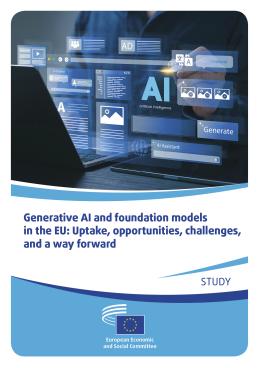
Exploring the evolving landscape of generative artificial intelligence (GenAI) within the European Union, this study delves into technological advancements, market dynamics, and regulatory challenges. It highlights the EU’s position in the global GenAI ecosystem, revealing significant US dominance, while uncovering sector-specific opportunities and risks across industries such as automotive, renewable energy, and education.
Economic and Social Council of Spain,
c/ Huertas, 73
Madrid
Spain
The 20th meeting of the EU-China Round Table took place in Madrid, Spain on 9 and 10 June 2025.
The EU-China Civil Society Round Table was established in 2007 following a decision taken by the 9th EU-China Summit in Helsinki. The delegations from the EESC and its Chinese counterpart, the China Economic and Social Council, meet regularly to discuss topics relating to economic and social issues relevant to both parties.
By elaborating reports, discussing them and exchanging ideas, the representatives of the European Economic and Social Committee and the China Economic and Social Council contribute to the development of the overall EU-China relationship, from a civil society perspective.
welcomes the EU's decision to promote the principle of the EU's open strategic autonomy, and therefore the launch of the Global Gateway initiative at the end of 2021;
argues that the Global Gateway will strengthen economic and political ties with the EU's partner countries, enabling the EU to compete effectively on a global level in the provision of infrastructure;
regrets the lack of real involvement of local European stakeholders in the overall process of development. The EESC would like to play a more active role in the key stages of the decision-making process for development projects associated with the BRI and the Global Gateway.
The External Relations Section (REX) of the European Economic and Social Committee (EESC) is responsible for dialogue between European civil society organisations and their homologues from the countries with which the European Union has formal relations (e.g. under the form of a Free Trade Agreement). Through this dialogue, made possible by a series of bilateral bodies, and through specialized opinions and information reports, the Committee is able to concretely contribute to EU foreign policy.
The 18th meeting of the EU-China Civil Society Round Table took place in Brussels on 14 December 2021 in a hybrid format that allows for both physical presence and remote participation.
On this occasion, delegations from the EESC and its Chinese counterpart, CESC, focused on post-Covid economic recovery and possible EU-China cooperation.
The Potential of Big Data, Health, Government, Economics and Policy Making, Banking, Finance and Retail, Education, The Risks of Big Data, Privacy, Security, Competition and Anti-trust, Human Rights, Workplace Issues, Digital Divide, The Global Situation
Big Data: The Digital Revolution and its Impact on Society Report by Michael McLoughlin and Oliver Röpke