
European Economic
and Social Committee
One market, 27 legal mazes: how a pragmatic 28th Regime can break the big maze
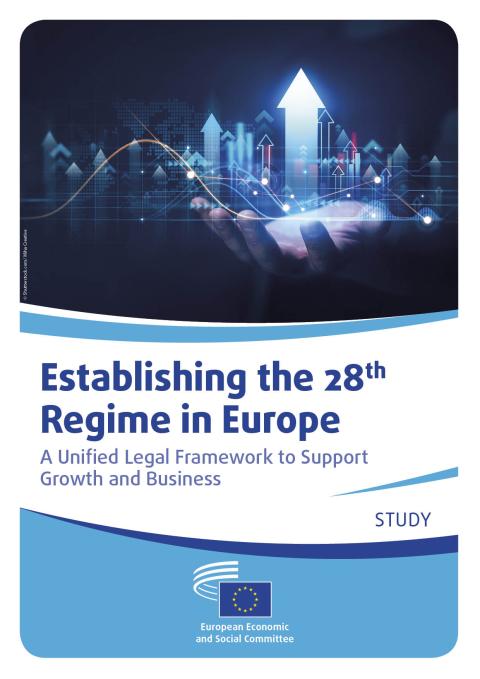
The European Union’s Single Market, often hailed as the crown jewel of European integration, promised frictionless trade and a level playing field. Yet today, it remains unfinished showing a patchwork of 27 national corporate laws, tax codes, accounting rules, and labour systems. For businesses operating across borders, this legal maze acts as invisible tariffs: up to 45% on goods and over 100% on services. Expanding across borders still means paying lawyers and accountants, not hiring engineers or sales teams.
Traditional routes toward unity—harmonisation and mutual recognition—have hit legal and political walls. The first requires unanimous agreement where national sensitivities run deep; the second crumbles when trust is thin. As a result, Europe competes as a collection of mid-sized markets, while the United States and China operate continental economies powered by scale.
This is why the European Commission is working on the idea of a 28th Regime — an optional EU-wide legal framework that coexists with, but does not replace, national systems — offers a way out of this maze. The logic of the proposal, to be presented early next year, is simple but transformative. Instead of forcing Member States to converge through slow, top-down harmonisation, create an optional EU‑wide framework that companies can choose voluntarily. A firm operating under this regime would follow one coherent set of rules across borders—one registration, one reporting system, one governance standard—without replacing national systems. Member States would be obliged to make the regime available but free not to use it themselves.
A recent study, commissioned by the EESC Employers' Group, argues that the 28th Regime represents a third functional way: a voluntary, opt-in framework that simplifies cross-border activity without eroding national sovereignty.
Its economic logic is clear: optional regimes can unleash economies of scale and investment flows while allowing national diversity to coexist. When well-designed, as with UCITS funds or the Unitary Patent, such frameworks deliver real convergence.
Still, Europe must learn from past failures. Initiatives like the Pan-European Pension Product (PEPP), the Societas Europaea (SE), and the proposed European Private Company (SPE) faltered because they lacked legal certainty, clear initiatives and user focus. Others stumbled on political resistance or the absence of strong stakeholder coalitions.
Optionality alone is not enough. Companies must see practical benefits—lower costs, faster registration, and easier access to markets—before they sign up.
That is why the study outlines seven guardrails. A true 28th Regime should be voluntary for users but mandatorily available in all Member States, legally anchored in the Treaties (Articles 114 or 50 TFEU), limited to areas where harmonisation is politically blocked; and built using existing institutions, not new bureaucracies. Most importantly, it must have a narrow, functional scope—enough to add value, not enough to add bloat. Discipline, not grandiosity, will make it work.
The initial focus should be business law, where the economic payoff is highest and political feasibility greatest. The study proposes a layered approach:
- Corporate Law (Foundation Layer): A unified EU incorporation and governance framework with one-time registration, multilingual filings, and mutual recognition of company acts.
- Taxation (Incentive Layer): Cross-border loss relief, group taxation, and non-discriminatory treatment to promote mobility.
- Accounting (Transparency Layer): Simplified, harmonised reporting standards managed by a European Accounting Standards Board working with EFRAG and national authorities.
- Insolvency (Lifecycle Layer): Coherent restructuring and liquidation rules enabling smoother capital reallocation.
- Labour Law (Constrained Layer): To be considered only at a later stage, given its political sensitivity and Treaty limits.
The biggest risks in this approach lie not in concept but in execution. Without early buy‑in, even the best framework risks irrelevance. The EU should therefore pilot before legislating—testing the concept through controlled national experiments (like Spain’s Régimen 20) or the European Commission’s Competitiveness Lab to test components.
Stakeholders from business and labour must co‑design the rules to ensure legitimacy and user orientation. This should be framed not as an institutional revolution but as a competitiveness tool: Europe making it easier to do business inside Europe, using existing institutions instead of new bureaucracies.
Digital tools can bring the idea to life. A “Business Single Entry Point” could enable registration, reporting, and compliance through one unified online portal. A clear accountability mechanism—with regular progress reviews and sunset clauses—would keep the regime adaptable and focused on results.
Europe has long debated how to reconcile diversity and unity. The 28th Regime is not a silver bullet, but it offers a middle ground—not though grand harmonisation, but through voluntary alignment. It would preserve national sovereignty while granting ambitious companies the freedom to think and act on a continental scale.
The Single Market was meant to dismantle walls. The 28th Regime, if carefully designed and pragmatically implemented, offers Europe the chance to clear away the rubble that remains. Europe cannot afford another decade of fragmentation disguised as integration. It is time to finish what it started and we at the EESC Employers' Group are attentive to the evolution of the file and engaging with other stakeholders to make the 28th Regime an implementable tool.
By Antonio Garcia Del Riego, member of the EESC Employers' Group.
Work organisation
Related content

Recommended for you
Współtworzenie usług publicznych w sektorze opieki zdrowotnej przyczyni się do silniejszej demokracji uczestniczącej w UE
News
Podczas wydarzenia zorganizowanego przez Europejski Komitet Ekonomiczno-Społeczny (EKES) i Uniwersytet w Debreczynie podkreślono kluczowe znaczenie współtworzenia usług świadczonych w interesie…
Zorganizowane społeczeństwo obywatelskie UE nie zostawi Ukrainy
News
Europejski Komitet Ekonomiczno-Społeczny (EKES) zorganizował 19 lipca konferencję wysokiego szczebla nt. pomocy dla Ukrainy i jej odbudowy. Podczas tego wydarzenia zobowiązał się w pełni i na…
Europejski Komitet Ekonomiczno-Społeczny w Gdańsku. - Wolontariusze potrzebują rządowego wsparcia
News
O tendencjach w rozwoju wolontariatu w Unii Europejskiej, o nowych formach wolontariatu, ale też o wsparciu organów publicznych dla organizacji i wolontariuszy i jego roli gospodarczej - o tym, i nie…
Nowy europejski Bauhaus niesie wszechstronne korzyści dla przyszłości Europy
News
Uczestnicy seminarium internetowego zorganizowanego przez Europejski Komitet Ekonomiczno-Społeczny (EKES) opowiedzieli się za tym, by nowy europejski Bauhaus służył obywatelom Europy i pomagał w…
Instrumentalizacja migrantów i ukraiński kryzys uchodźczy wymagają ponownego namysłu nad polityką migracyjną
News
Finansowana przez państwo instrumentalizacja migrantów w celu destabilizacji UE oraz wojna w Ukrainie, która doprowadziła do niespotykanego dotąd napływu uchodźców, sprawiają, że niezbędny staje się…