
European Economic
and Social Committee
In search of European prosperity innovation is key
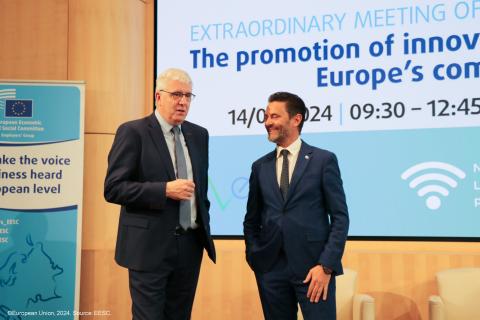
Article by Stefano Mallia (President of the EESC Employers' Group) and Pieter Timmermans (CEO of the Federation of Belgian Enterprises)
Economic growth is driven by innovation, modernization and research and development. It’s a message that countries such as the US and China have understood early on, and have invested heavily towards. Unfortunately it’s also exactly where the EU is losing ground to its global competitors.
Regulation hampers innovation
The reason why Europe is lagging behind is partly because of its imposed regulations which sometimes creates unexpected barriers for research and innovation. And translates directly into time, energy and money which they cannot invest in value creation and growth.
This is problematic since innovation is critical for achieving Europe's green and digital transitions towards sustainability and for strengthening Europe's competitiveness.
Therefore, strengthening the EU’s research and innovation performance should be a key strategic priority for the next European Commission between 2024-2029.
Initiatives must encourage innovation
To regain a global technological leadership position and bring more innovative products and services to market, the EU must firstly identify key strengths and weaknesses of the European innovation landscape, and develop a framework on how to best overcome them.
Secondly, Europe and its institutions should harness the principle of innovation and technology neutrality to guide policymaking, and base their approach on the broad scientific consensus.
A new Innovation Stress Test – as proposed by the Belgian Presidency of the Council - for the evaluation of each new legislation and policy initiative could then become an impactful instrument for enhancing the EU’s innovation ecosystem. It would be a practical and easily implementable guidance for policymakers to verify proposed legislation would not negatively impact Europe’s innovation efforts and competitiveness.
Of course, the tool will only be able to have a positive impact on European innovation if the European Commission systematically uses it and monitors its application. In addition, the tool could have an equally positive impact if used by policymakers in EU member states, and even at regional and local levels.
For a stronger Europe in the world, where it becomes the region of choice for entrepreneurship, innovation and investment, the EU must fully focus on promoting innovation in all its forms and make it one of the strategic priorities for the next European legislature of 2024-2029.