589th Plenary session, with the following guests: Roberta Metsola, President of the EP (tbc);János Bóka, Minister of EU Affairs of Hungary; Nicolas Schmit, EU Commissioner for Jobs and Social Rights, Maxime Cerutti, Director of Social Affairs at Business Europe, Tea Jarc, Confederal Secretary of the EU Trade Union Confederation (ETUC), Rareș Voicu, President of the EU Youth Forum and Nicoletta Merlo, EESC Member; with Teresa Ribera, Minister for the Ecological Transition and the Demographic Challenge of Spain (tbc), Svenja Schulze, Federal Minister for Economic Cooperation and Development of Germany (tbc); Saadia Zahidi, Managing Director, World Economic Forum
The debate will start at 12.00 and end at 13.00 CEST. It will be webstreamed in English, French and Spanish. Prior registration for the webstreaming is not necessary. It will be available on this website on the day of the event.
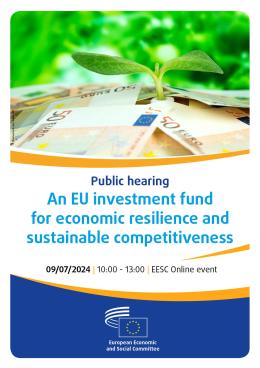
The Section for Economic and Monetary Union and Economic and Social Cohesion (ECO) of the European Economic and Social Committee (EESC) is working on an own-initiative opinion on 'An EU investment fund for economic resilience and sustainable competitiveness' with the aim to develop a common narrative on the financing needs for the green transition and sketch out central elements of an EU investments fund that could allow EU Member States to more effectively address the financial needs of the Green Deal.
In the context of the work on this opinion, the ECO section decided to organise a public hearing bringing together experts from organised civil society and decision-makers. The aim of the public hearing is two-fold: on the one hand, to discuss the draft EESC opinion, and on the other hand, to collect further views and ideas to expand and refine the EESC's draft recommendations.
Room VMA 22 EESC building & Interactio, Rue Van Maerlant 2, 1040
Brussels
Belgium
The EESC's Permanent Group on disability Rights is organising a hybrid public hearing on " Ensuring sexual and reproductive health rights for women with disabilities " on 8 July 2024 from 9:30 am to 1 pm.
During the event, we will discuss with relevant stakeholders existing good practices as well as problems encountered by women with disabilities both in the EU and on a global level.
Towards democratic practices in public spending, the workplace, urban planning and public services
Event type
Conference
Location
rue van Maerlant 2
Brussels
Belgium
In collaboration with the European Economic and Social Committee (EESC) and the Open Society Foundations (OSF), FEPS will organise a conference on 3 July 2024 between 09:00 – 16:00 to discuss approaches and practices that help build and scale up economic democracy. Hosted at the EESC, this event will bring together researchers, practitioners, policymakers and activists in the field.
Conference organised by the EESC's Consumers and Environment Category
Location
Van Maerlant street 2, room VMA 22
Brussels and online
Belgium
Join us on 3 July 2024 for a morning discussion forum in the Consumers and Environment category, with the aim of anticipating and influencing the upcoming decisions that will follow the renewal in the European Parliament and the European Commission. This is an in-person conference that will be live streamed on our website. Registration closed on 1 July 2024.
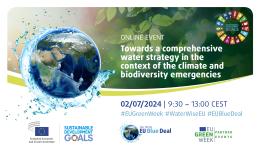
This event, organized by the Sustainable Development Observatory (SDO) in cooperation with the Consultative Committee on Industrial Change (CCMI), follows up on the EESC's call for an EU Blue Deal. We'll examine the role of water in the climate and biodiversity emergencies we face, seeking cohesive, sustainable solutions for water resilience.
The EESC is organising this public hearing to discuss the strengths and weaknesses of the legislative framework on securitisation, as well as risks related to securitisation and possible policy solutions.
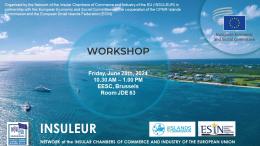
Hybrid workshop organized by the Network of the Insular Chambers of Commerce and Industry of the EU (INSULEUR) in partnership with the EESC #EESCPartnership
Location
Rue Belliard 99, 1040 Brussels, Belgium
The hybrid workshop "European Islands Economies Need More Attention at the New Cohesion Policy After 2027," organized by INSULEUR in partnership with the EESC, and with cooperation from the CPMR Islands Commission and ESIN, will take place on June 28, 2024, at the EESC in Brussels. This event will address the unique economic challenges of European islands, emphasizing the need for focused attention on these economies in the EU's post-2027 Cohesion Policy.
The workshop will highlight the importance of ensuring that island territories receive adequate support, considering their severe natural and demographic handicaps. Discussions will focus on the necessity of flexible state aid and tailored measures to address their specific needs, especially in light of the economic setbacks from the Covid-19 pandemic. Emphasis will be placed on the critical role of SMEs in these regions and the need for community funding to support their sustainable transition, innovation, and resilience.
80% of Roma remain at risk of poverty, far more than the rate of 16.8% for the general population. Whilst surveys show a decrease in the rate of Roma living in severe material deprivation, this still contrasts sharply to the rate amongst non-Roma. Reducing this poverty gap is one of the main objectives of the new EU Roma strategic framework, which foresees to cut this by half by 2030. The hearing will look at recent surveys on poverty amongst the Roma. It will discuss in more detail how EU policies on combatting poverty can be taken forward and contribute to improving the situation of the Roma community. It will also discuss measures and good practices on how the poverty gap can be narrowed.