
European Economic
and Social Committee
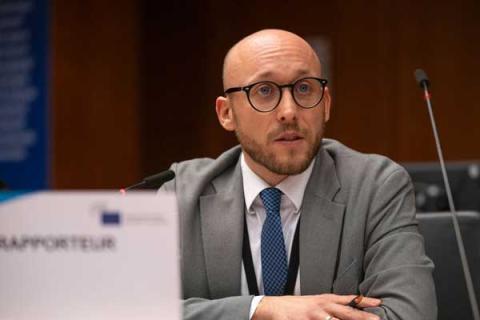
After three years of Russia's full-scale invasion of Ukraine, what is the state of play concerning displaced Ukrainians in EU Member States? by Mateusz Szymanski
After three years of Russia's full-scale invasion of Ukraine, what is the state of play concerning displaced Ukrainians in EU Member States?
Russia's aggression against Ukraine has created a situation that the EU has never faced before, namely an influx of not thousands, not hundreds of thousands, but millions of people fleeing the war. Thanks to the commitment of the Member States and its’ citizens, we have managed to meet this challenge and have taken in refugees, providing them with safe shelter.
At that time, an extremely important decision was also taken for the first time to grant Ukrainians arriving in the EU so-called temporary protection. This is a solution that allows for immediate and collective (i.e., without the need to consider individual applications) protection for displaced persons who are unable to return to their country of origin. The aim of the mechanism is to enable them to enjoy harmonized rights throughout the Union. Employment and education are central to the rights enjoyed by displaced persons from Ukraine in the EU, in addition to accommodation, healthcare, and social assistance.
It is estimated that more than 4 million people currently enjoy temporary protection in the EU. Most of them are in Germany, Poland, and the Czechia. The majority are women and children. Today, questions about how to approach the long-term stay of refugees from Ukraine are becoming relevant. There are a number of issues that need to be discussed. First and foremost, this is to avoid increasing tensions and to prevent those who want to exploit this issue for their own political purposes from gaining ground.
Key issues include ensuring access to public services and creating conditions for Ukrainians to engage in the labour market. We know that there are a number of barriers that prevent Ukrainians from finding employment (e.g., the requirement to know the language of the host country). Unfortunately, there are also cases of unfair employment practices against Ukrainians. Another important challenge is to make urgent efforts to increase access to the housing market.
However, the above applies to the situation within the EU. And we are looking for a long-term plan for Ukrainians in the EU. This must also take into account the situation in which at least some of them will return home when the situation stabilizes and Ukraine becomes safe. That is why we at the EESC are already saying that it is important to use the frozen Russian funds held in EU banks for reconstruction, and that this reconstruction should also include efforts to implement socially friendly reforms, including, above all, labor market regulation and the fight against corruption.
Above all, it is necessary to start talking about the future now and prepare for concrete solutions. Temporary protection cannot last forever. It has already been extended several times. This creates uncertainty and, in a sense, contradicts the idea of temporary protection. Member States should therefore prepare their administrative apparatus and encourage Ukrainians to legalize their stay in the EU now, by means other than temporary protection.
How can EESC help with their integration and working conditions in the EU Member States?
In line with its fundamental role, the EESC recommends ways of operationalizing political decisions. Currently, it has been agreed at EU Council level to extend temporary protection until March 2027, but it has also been proposed to discuss the future of Ukrainians in the EU. The EESC has therefore put forward its own suggestions on how to create the conditions for the return and integration of Ukrainians in the EU.
The EESC seems particularly well placed to do so, given its special insight into the situation at local level. Hence the EESC's specific recommendations, which concern, among other things, working conditions. On the one hand, we see that there are cases of abuse. We cannot accept this. We expect the law to be properly enforced. On the other hand, we know that Ukrainians often work below their qualifications, which is also an unfavorable situation. There must be effective mechanisms for recognizing their qualifications. On yet another level, we mention in our opinion how important it is to be economically active and participate in civil society organizations, including trade unions, which could effectively defend the rights of Ukrainian workers in Poland. This would also build good relations and trust.
We must also bear in mind the situation in Ukraine itself. Unfortunately, over the years, and not only during the recent war, there has been far-reaching liberalization of labor law. The authorities make no secret of their aversion to trade unions and social dialogue. An assessment of these regulations suggests that they very often contradict the fundamental labor standards of the International Labor Organization. There is no justification for denying workers their fundamental rights, which, as is often forgotten, are basic human rights.
What gives cause for some optimism is the fact that a tripartite memorandum has been signed on labor reforms, which are ultimately intended to bring them closer to international standards. Let us hope that this will happen.
The EESC will certainly continue its work on this issue. It is very important. In addition, the EESC has bodies dedicated to cooperation with Ukraine, where this discussion can also be continued. Importantly, EESC members remain in contact with Ukrainian citizens living in the EU through their networks.