The European Union needs not only to improve the preparedness of its health system but also to address inequalities within the Union and globally. It needs to move quickly to assess the public health action taken to date
The European strategy for data proposed the establishment of domain-specific common European data spaces. The European Health Data Space (‘EHDS’) is the first proposal of such domain-specific common European data spaces. It will address health-specific challenges to electronic health data access and sharing, is one of the priorities of the European Commission in the area of health and will be an integral part of building a European Health Union. EHDS will create a common space where natural persons can easily control their electronic health data. It will also make it possible for researchers, innovators and policy makers to use this electronic health data in a trusted and secure way that preserves privacy.
Download format:
Download — advies EESC: European Health Data Space
This opinion draws attention to the needs of family members taking care of older, chronic ill or disabled relatives. Informal carers, as they are called, represented by a majority of women, work for free, and are more vulnerable to falling into poverty. The opinion calls for public policies in this field and a recognition of their important societal role.
Download format:
Download — advies EESC: The role of family members caring for people with disabilities and older persons: the explosion of the phenomenon during the pandemic
Rare diseases are often chronic and sometimes disabling diseases affecting an estimated 25/30 million European citizens. Even more people are affected as care taker or family. Patients and relatives face difficulties in access to diagnosis, treatment or care and in their inclusion to society and labour market. In this opinion, the EESC presents its recommendations on how to improve social protection for these patients and raise awareness on their situation and needs.
Download format:
Download — advies EESC: Ensuring strong European solidarity for rare disease patients
Although it has great potential, HERA - the EU's new body for fighting future health emergencies across borders – falls short on transparency and ambition. With few checks and balances in place for its work, there are doubts as to whether HERA will be able to fulfil its public health mission, rather than giving a predominant role to the pharmaceutical industry
Interactio and Room JDE 60, EESC building, Rue Belliard 99, 1040
Brussels
Belgium
In the context of the own-initiative opinion on ''The role of civil society organisations as guardians of the common good in the post-pandemic recovery'', the European Economic and Social Committee (EESC) is organising a remote public hearing on Monday 28 March 2022.
Interactio and Room JDE 60, EESC, Rue Belliard 99, 1040
Brussels
Belgium
In order to prepare its opinion on the proposals by the European Commission on the European Drugs Agency, the EESC is organising a remote public hearing on 9 March 2022 from 9:30 am to 1 pm.
The aim of the event is to discuss the proposal and gather input from other EU Institutions, international organisations and civil society, which will feed into the EESC's opinion.
Interactio and Room JDE 62 and 63 , EESC building, Rue Belliard 99, 1040
Brussels
Belgium
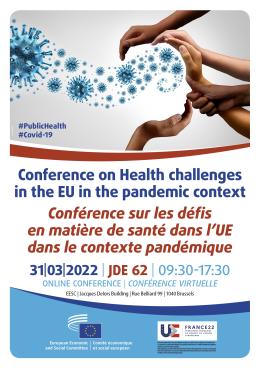
The EESC is organising a virtual conference on "Health challenges in the EU in the pandemic context" on 31 March 2022 (9h30 to 17h30).
The aims of the conference will be to look into possible actions to exit the cross cutting crisis caused by the COVID-19 pandemic, to prevent the next health threat from spiraling out of control, and to build stronger and more resilient health systems for the future.
This opinion presents the EESC's contribution to the current discussion on the future of care and health across Europe and to the European Care Strategy. The Committee recommends setting common minimum standards to ensure that every one living in the EU has access to affordable, accessible and high-quality care, that there is proper investment in the care services and in health, that the health sector, care providers and health workers are properly recognised and valued, including through investment in skills, decent working conditions, and the creation of quality jobs.
Download format:
Download — advies EESC: Health Workforce and Care Strategy for the future of Europe