
European Economic
and Social Committee
EESC backs priorities of French EU Presidency
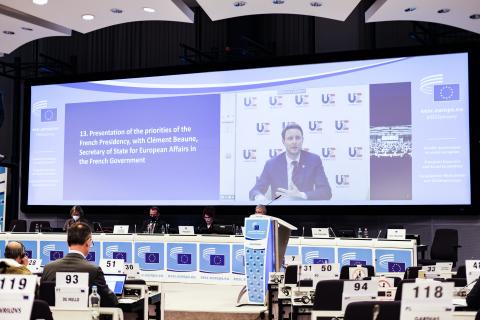
At its January plenary, the European Economic and Social Committee (EESC) threw its support behind the agenda of the French Presidency of the Council of the European Union focusing on the following watchwords: resilient, strong, sustainable and inclusive Europe.
Recovery, strength and a sense of belonging are the three main objectives of the French Presidency, which the EESC shares and supports, as its president Christa Schweng made clear at the January plenary session on 19 January 2022 when addressing the French Secretary of State for European Affairs Clément Beaune.
Looking at your priorities - a more sovereign Europe, a new European model for growth and a humane Europe - I am happy to see that many of these priorities are very similar to those of the EESC,
said Ms Schweng, highlighting the EESC's commitment and contribution to shaping a resilient, strong, sustainable and inclusive Europe.
European values at the heart of the French Presidency agenda
Mr Beaune stressed that the French Presidency would help prepare the Europe of tomorrow, with an eye to 2030, laying the groundwork for far-reaching changes on values, investment, youth, culture and health. Special focus would be placed on promoting the values uniting us all but which had weakened in recent years, perhaps because they were seen as a given, such as the rule of law and democratic values. We want to foster a sense of belonging and champion our values. There will not be a political project without this common European identity beyond the national identities,
he said.
The programme for the French Presidency will therefore have three ambitions: a Europe that is more sovereign, has a new model for growth and is humane.
A more sovereign Europe is a Union that focuses on: strengthening the Schengen area, protecting European borders, controlling migration and improving asylum policy, in line with Europe's values and its international commitments; building stronger security and defence; taking action for the prosperity and stability of its neighbours, particularly through its engagement in the Western Balkans and its renewed relationship with Africa; and putting forward solutions to global challenges.
The second priority, a new European model for growth, deals with making Europe a land of production, job creation, innovation and technological excellence; in which economic development goes hand in hand with climate goals; supporting innovation and the growth of European digital players and setting its own rules for the digital world; and offering high-quality, high‑skilled and better-paying jobs.
Finally, a humane Europe is an EU that listens to the concerns expressed by its citizens through the Conference on the Future of Europe; that defends the rule of law and upholds its values; that takes pride in its culture, trusts in science and knowledge, and is committed to fighting discrimination and securing a future for the next generation.
Joining forces for the success of the Conference on the Future of Europe
With reference to the upcoming conclusion of the Conference on the Future of Europe, Ms Schweng added that as the house of European organised civil society, we can be your best allies in this sensitive final phase. Ensuring tangible results and transparent follow-up will be crucial. People will need transparency and seeing that the EU is "walking the talk". The role of the French Presidency, therefore, will be key for the Conference's success and for giving the EU back to its citizens.
Mr Beaune reassured the audience by underlining that the Conference on the Future of Europe, when it concludes in May, would bring about concrete proposals, such as a new European governance model, that it is essential to implement rapidly, because the Conference cannot be an artificial exercise but is meant to prepare the ground for real reform.
Voicing civil society's concerns
During the ensuing debate with the EESC members, Stefano Mallia, president of the EESC Employers' Group, was pleased to note that the priorities of the French Presidency were in line with the needs of European enterprises, but called for a strong intervention to ensure that the Conference on the Future of Europe did provide value added not only for citizens but also for the millions of enterprises that continued to provide jobs and growth.
Oliver Röpke, president of the EESC Workers' Group, shared Mr Mallia's concerns, emphasising that the Conference on the Future of Europe had to keep its promises, deliver concrete results reflecting the demands of citizens and organised civil society and must continue after May, because Social Europe must not remain only a slogan.
Finally, Séamus Boland, president of the EESC Diversity Europe Group, pointed out that the challenges facing individual countries required supranational responses and although social policy remained the prerogative of Member States, the EU, supported by the French Presidency, should encourage its upward convergence.
Downloads
-
EESC backs priorities of French EU Presidency
Recommended for you
YEYS! 2023: Jongeren vragen een EU die transparanter, digitaler en eenvoudiger is
News
Op 23 en 24 maart is bij het Europees Economisch en Sociaal Comité (EESC) de veertiende editie van Jouw Europa, jouw mening! (YEYS!) gehouden. Voor dat evenement kwamen 105 leerlingen van 35 scholen…
De elektriciteitsmarkt van de EU moet worden hervormd
News
Uit een door het Europees Economisch en Sociaal Comité (EESC) georganiseerd debat kwam naar voren dat het van cruciaal belang is de Europese elektriciteitsmarkt aan te passen om de zwakke punten…
Kandidaten kunnen zich nu aanmelden voor de EESC-prijs voor het maatschappelijk middenveld, die dit jaar geestelijke gezondheid als thema heeft
News
Maatschappelijke organisaties, individuen en particuliere ondernemingen kunnen nu met hun non-profitprojecten meedingen naar de EESC-prijs voor het maatschappelijk middenveld, die deze keer in het…
EESC roept de EU-burgers op om in juni 2024 te stemmen voor een verenigd en democratisch Europa
News
Tegen de achtergrond van een wereldwijde achteruitgang van de democratie, welig tierende desinformatie, groeiende ontevredenheid, stijgende inflatie en oorlogsdreiging, staat er veel op het spel bij…
De sociale en burgerdialoog kunnen de EU helpen duurzaam te groeien
News
Slechts enkele dagen na de Europese verkiezingen van 2024 kwamen het Europees Economisch en Sociaal Comité (EESC) en de nationale sociaal-economische raden van de EU bijeen om de stand van zaken van…