
European Economic
and Social Committee
EESC President Séamus Boland: Europe must act together to eradicate poverty by 2050
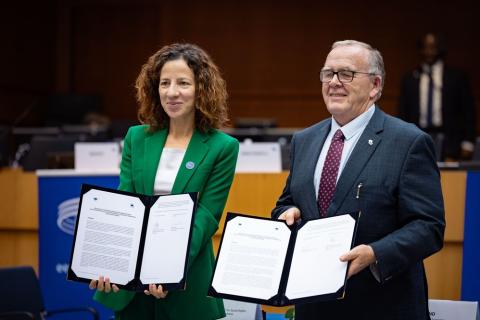
The European Economic and Social Committee (EESC) and the European Commission signed a Memorandum of Understanding to strengthen their cooperation in the fight against poverty and social exclusion. EESC President Séamus Boland, EU policymakers, civil society representatives, social partners and people with lived experience of poverty discussed how Europe can accelerate progress towards eradicating poverty by 2050 at a debate hosted by the EESC.
The high-level debate, entitled ‘Eradicating Poverty by 2050: fulfilling our collective responsibility’, took place during the EESC’s October plenary session in Brussels. It brought together representatives of EU institutions, national governments, civil society, international organisations, social partners and organisations working directly with people experiencing poverty. A key moment was the signing of the Memorandum of Understanding between the European Commission, represented by Executive Vice-President Roxana Mînzatu, and the EESC, represented by its President, Séamus Boland.
The memorandum establishes a framework for cooperation on implementing the EU Anti-Poverty strategy, the strengthened European Child Guarantee and advancing related initiatives to combat poverty and social exclusion. It provides for enhanced political dialogue, including annual EESC plenary debates and regular exchanges between the responsible European Commissioner and the EESC President. The Commission and the EESC will jointly identify areas where the Committee’s input could be particularly valuable, with the relevant bodies of both institutions working more closely together. Priority will be given to policy initiatives and actions relevant to employers, workers and civil society organisations.
The EESC will contribute through its opinions and analytical work, consultations with these groups, and support for implementation and monitoring. The memorandum also emphasises involving people experiencing poverty in the policymaking process and ensuring support for outreach to the future EU Coalition Against Poverty.
‘I very much welcome the inclusive approach of the EU Anti-Poverty strategy. Now we need to turn words into action and tackle a problem that officially affects around 90 million people,’ said Mr Boland. He stressed that reducing poverty requires action across interconnected areas, including income, employment, education, housing, healthcare, care services and access to essential services. He also called for measurable targets, the effective use of European funding, sustained national investment and annual assessments of poverty in each Member State through the European Semester.
Ms Mînzatu underlined that the EU Anti-Poverty strategy marked a step forward in accelerating progress towards the EU’s 2030 anti-poverty goals and its longer-term ambition of eradicating poverty across the continent by 2050. ‘We need to fulfil our collective responsibility. And collective responsibility must lead to collective action. Through the signature of the Memorandum of Understanding we are giving tangible expression to our shared commitment. This is more than a formal step: it is a sign of our common determination to work together more closely, to strengthen our dialogue and to turn our shared ambitions into practical results,’ she said.
In a video message, Dara Calleary, Ireland’s Minister for Social Protection and Minister for Rural and Community Development, representing the Irish Presidency of the Council of the EU, highlighted the need for cross-border cooperation. ‘No country can achieve the ambition of eradicating poverty by acting alone. Success will require sustained cooperation among Member States, European institutions, social partners, civil society, communities and those with direct experience of poverty and social exclusion,’ he said. For his part, Carlos Susías, President of the European Anti-Poverty Network (EAPN), stressed that the EU Anti-Poverty strategy must be reflected in the 2028–2034 multiannual financial framework (MFF), currently under negotiation, amid concerns that Member States may push for substantial budget cuts. ‘If the MFF is not consistent with our strategies and the European Pillar of Social Rights, we will not achieve our objectives,’ he warned.
Breaking the cycle of disadvantage
Conference participants heard the findings of the EESC-commissioned study Breaking the cycle of disadvantage: reviewing EU policy through the lens of poverty. The discussion examined how Europe can prevent poverty from taking root in childhood, stop disadvantage from passing between generations and ensure dignity and security in later life.
Speakers highlighted the importance of early investment in children and families, high-quality education and care, adequate income support, fair wages, affordable housing and accessible essential services. They also addressed the challenges faced by young people not in employment, education or training, as well as persistent poverty risks among older people, particularly women, people with disabilities and those with interrupted or precarious careers.
The debate was organised around three sessions: Navigating the road ahead, Ending intergenerational poverty and Jointly preventing and protecting against poverty. It formed part of a broader series of EESC initiatives to combat poverty. During its October plenary session, the Committee addressed intergenerational poverty, the strengthened European Child Guarantee, housing exclusion and homelessness, and the role of civil society in advancing sustainable development. The EESC has consistently argued that income support alone cannot eradicate poverty, as effective action also requires quality employment, fair wages, robust social protection, affordable housing and access to essential services. Policies must be developed with the active participation of people experiencing poverty, social partners and civil society organisations.
Work organisation
Recommended for you
YEYS! 2023: Jongeren vragen een EU die transparanter, digitaler en eenvoudiger is
News
Op 23 en 24 maart is bij het Europees Economisch en Sociaal Comité (EESC) de veertiende editie van Jouw Europa, jouw mening! (YEYS!) gehouden. Voor dat evenement kwamen 105 leerlingen van 35 scholen…
De elektriciteitsmarkt van de EU moet worden hervormd
News
Uit een door het Europees Economisch en Sociaal Comité (EESC) georganiseerd debat kwam naar voren dat het van cruciaal belang is de Europese elektriciteitsmarkt aan te passen om de zwakke punten…
Kandidaten kunnen zich nu aanmelden voor de EESC-prijs voor het maatschappelijk middenveld, die dit jaar geestelijke gezondheid als thema heeft
News
Maatschappelijke organisaties, individuen en particuliere ondernemingen kunnen nu met hun non-profitprojecten meedingen naar de EESC-prijs voor het maatschappelijk middenveld, die deze keer in het…
EESC roept de EU-burgers op om in juni 2024 te stemmen voor een verenigd en democratisch Europa
News
Tegen de achtergrond van een wereldwijde achteruitgang van de democratie, welig tierende desinformatie, groeiende ontevredenheid, stijgende inflatie en oorlogsdreiging, staat er veel op het spel bij…
De sociale en burgerdialoog kunnen de EU helpen duurzaam te groeien
News
Slechts enkele dagen na de Europese verkiezingen van 2024 kwamen het Europees Economisch en Sociaal Comité (EESC) en de nationale sociaal-economische raden van de EU bijeen om de stand van zaken van…