
European Economic
and Social Committee
EESC Fundamental Rights and Rule of Law Group concludes a visit to North Macedonia
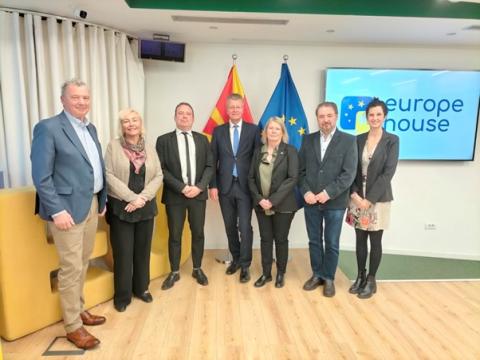
EESC Fundamental Rights and Rule of Law Group concludes a visit to North Macedonia
On 10-11 March 2026, the Fundamental Rights and Rule of Law (FRRL) Group of the European Economic and Social Committee (EESC) concluded a two-day visit to Skopje.
This visit formed part of the second cycle of FRRL Group country visits (2024–2029), following the first cycle (2018–2024). The methodology of the Group combines exchanges with civil society, national authorities, and representatives of the European Commission, ensuring that all relevant perspectives are heard.
This visit gave the opportunity to the group of six EESC Members to hear civil society representatives about key trends in North Macedonia concerning fundamental rights of social partners, freedoms of association and assembly, freedom of expression (including media freedom), the right to non-discrimination, and the rule of law.
Participants in the discussions particularly highlighted:
low participation in organisations, limited effectiveness of social dialogue mechanisms and the Economic and Social Council, a prolonged standstill of collective bargaining in the private sector and challenges to trade union organising in companies operating within Special Economic Zones;
gaps in the legal framework, where laws exist but implementing bylaws are missing or adopted through non‑transparent processes, concerns over the sustainability of CSOs due to low public funding and cuts to foreign funding programmes;
a fragile media environment, characterised by financial instability of media outlets, declining quality of journalism, weak professional status and growing self‑censorship among journalists, as well as exposure to foreign disinformation;
the weakening of equality bodies, discrimination against women in the workplace, lack of access to work and integration programmes for asylum seekers, obstacles for transgender persons in changing documents, accessibility barriers for persons with disabilities, segregation of Roma children in education, and the spread of anti‑gender and anti‑rights narratives;
rule of law and anti‑corruption shortcomings, reflected in understaffed and underfunded judicial systems, political interference in the judiciary, weak enforcement of anti‑corruption measures, and the ineffective implementation of lobbying legislation.
This was the first visit to North Macedonia, as the FRRL group decided to include EU candidate countries in the second cycle of country visits.
The EESC delegation also discussed with the Delegation of the European Union and the authorities of North Macedonia.
A report, including the observations of the MK authorities, will be issued in the coming months and will be presented in the EESC.
The delegation of the FRRL Group to North Macedonia was composed of:
José Antonio MORENO DÍAZ (Group II, Spain)
Cristian PÎRVULESCU (Group III, Romania)
Ariane RODERT (Group III, Sweden)
Jože SMOLE (Group I, Slovenia)
Klaus-Peter STILLER (Group I, Germany)
Maria ÖSTBERG SVANELIND (Group II, Sweden)
Background
The EESC established in 2018 a Group on Fundamental Rights and the Rule of Law (FRRL Group), which is tasked to provide a forum for European civil society organisations to meet and discuss fundamental rights, democracy and the rule of law. The FRRL Group promotes respect for the European values listed in Article 2 TEU by raising awareness of and assessing the state of play of these values in the Member States and allowing for the exchange of good practices. To this end, the FRRL Group hosts hearings, conferences, and carries out country visits with the aim of identifying trends in Europe concerning fundamental rights and the rule of law, inasmuch as they develop in national contexts.
Country visit reports are issued along with the observations of the authorities, a few months after the visits (they can be accessed here). After a first cycle of visit to all EU Member States (2018-2024), the FRRL Group started a second cycle of visits in 2024 to the 27 Member States and candidate countries. The Report synthesising the first cycle of country visits led in 2018-2019, 2020-2021, 2022, and 2023-2024 are available, as is the report on the overall first cycle (2018-2024).
For more information about the EESC FRRL Group methodology, see this document.
Work organisation
Recommended for you
YEYS! 2023: Jongeren vragen een EU die transparanter, digitaler en eenvoudiger is
News
Op 23 en 24 maart is bij het Europees Economisch en Sociaal Comité (EESC) de veertiende editie van Jouw Europa, jouw mening! (YEYS!) gehouden. Voor dat evenement kwamen 105 leerlingen van 35 scholen…
De elektriciteitsmarkt van de EU moet worden hervormd
News
Uit een door het Europees Economisch en Sociaal Comité (EESC) georganiseerd debat kwam naar voren dat het van cruciaal belang is de Europese elektriciteitsmarkt aan te passen om de zwakke punten…
Kandidaten kunnen zich nu aanmelden voor de EESC-prijs voor het maatschappelijk middenveld, die dit jaar geestelijke gezondheid als thema heeft
News
Maatschappelijke organisaties, individuen en particuliere ondernemingen kunnen nu met hun non-profitprojecten meedingen naar de EESC-prijs voor het maatschappelijk middenveld, die deze keer in het…
EESC roept de EU-burgers op om in juni 2024 te stemmen voor een verenigd en democratisch Europa
News
Tegen de achtergrond van een wereldwijde achteruitgang van de democratie, welig tierende desinformatie, groeiende ontevredenheid, stijgende inflatie en oorlogsdreiging, staat er veel op het spel bij…
De sociale en burgerdialoog kunnen de EU helpen duurzaam te groeien
News
Slechts enkele dagen na de Europese verkiezingen van 2024 kwamen het Europees Economisch en Sociaal Comité (EESC) en de nationale sociaal-economische raden van de EU bijeen om de stand van zaken van…