
European Economic
and Social Committee
European Migration Forum – The Key Role of Civil Society in Shaping EU Migration Policies
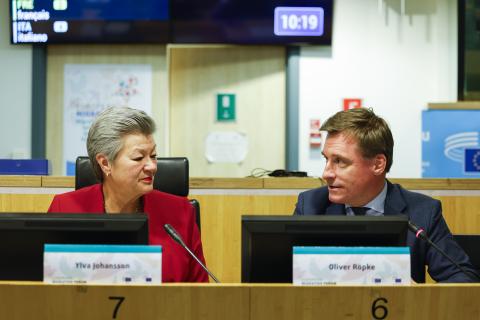
The 8th European Migration Forum (EMF), organised by the European Economic and Social Committee (EESC) and the Directorate-General for Migration and Home Affairs, explored questions around migrants' vulnerabilities, bridging the skills gap and countering prejudice surrounding migration.
A key point in the discussions was how to ease legal pathways to attract much-needed talent. In the face of Europe's growing labour shortage, the European Commission has just unveiled the Mobility Toolbox, a toolkit designed to facilitate the integration of third country nationals into the workforce. With 3.5 million migrants arriving legally in the EU last year, 1.2 million specifically for labour purposes, effective integration strategies will be of crucial importance.
The EU Commissioner for Home Affairs, Ylva Johansson, provided updates on critical policy initiatives and the current state of affairs in Europe. Never underestimate the skills and potential that migrants bring", she emphasised. "Integration is not about assimilating into a country; it's about becoming part of a community. And that's where civil society plays a pivotal role.
While the Mobility Toolbox marks a positive step forward, participants in the forum called for a more comprehensive approach. This includes streamlined recognition processes for foreign qualifications, access to language courses, and vocational training at both national and regional levels.
The President of the EESC, Oliver Röpke, remarked I pledged in my manifesto to 'stand up for democracy', which at its core is all about values of freedom, tolerance, equality, and respect. The narratives around migration must be grounded in these values to fight disinformation.
The EESC has already taken concrete action on critical themes related to the EMF, advocating the protection of unaccompanied migrant minors, pushing for a revision of the anti-trafficking directive, and implementing measures to improve mental health. President Röpke underscored the role of civil society in shaping inclusive migration policies, positioning the EESC as a vital link between citizens and EU institutions.
Fostering a welcoming and supportive environment for migrants is essential to their successful integration into the labour market. This involves combating discrimination and xenophobia, promoting intercultural understanding, and ensuring access to essential services such as housing and healthcare.
Work organisation
Recommended for you
Decision repealing Directive 89/629/EEC
Opinion
HOOFDPUNTEN Het EESC: stemt in met het voorstel, heeft er geen commentaar op en heeft daarom besloten er een positief advies over uit te brengen.
RePowerEU Plan
Opinion
HOOFDPUNTEN Het EESC: beschouwt het REPowerEU-plan van de Europese Commissie als een stap in de goede richting om de EU onafhankelijk te maken van de Russische gas- en olielevering; wijst erop…
Individual and collective energy self-consumption as a factor in the fight for the green and energy transition, and for economic and social balance
Opinion
Individueel en collectief zelfverbruik van energie als factor in de strijd voor de groene en energietransitie en voor economisch en sociaal evenwicht Hoofdpunten Het EESC: is van mening dat de…
Equity and efficiency considerations for maritime transportation
Opinion
Rechtvaardigheid en efficiëntie in het zeevervoer Hoofdpunten Het EESC: onderstreept dat de groene transitie van de scheepvaartsector rekening moet houden met landspecifieke, sectorspecifieke en…
Open Dag van de Europese instellingen
Event
Op zaterdag 6 mei kon het Europees Economisch en Sociaal Comité (EESC) samen met de andere EU-instellingen in Brussel voor het eerst sinds de COVID-19-crisis zijn deuren weer openen ter gelegenheid…