
European Economic
and Social Committee
European Migration Forum – The Key Role of Civil Society in Shaping EU Migration Policies
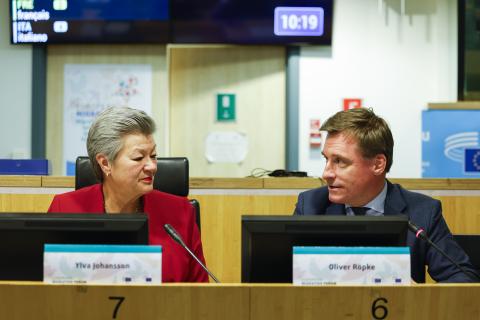
The 8th European Migration Forum (EMF), organised by the European Economic and Social Committee (EESC) and the Directorate-General for Migration and Home Affairs, explored questions around migrants' vulnerabilities, bridging the skills gap and countering prejudice surrounding migration.
A key point in the discussions was how to ease legal pathways to attract much-needed talent. In the face of Europe's growing labour shortage, the European Commission has just unveiled the Mobility Toolbox, a toolkit designed to facilitate the integration of third country nationals into the workforce. With 3.5 million migrants arriving legally in the EU last year, 1.2 million specifically for labour purposes, effective integration strategies will be of crucial importance.
The EU Commissioner for Home Affairs, Ylva Johansson, provided updates on critical policy initiatives and the current state of affairs in Europe. Never underestimate the skills and potential that migrants bring", she emphasised. "Integration is not about assimilating into a country; it's about becoming part of a community. And that's where civil society plays a pivotal role.
While the Mobility Toolbox marks a positive step forward, participants in the forum called for a more comprehensive approach. This includes streamlined recognition processes for foreign qualifications, access to language courses, and vocational training at both national and regional levels.
The President of the EESC, Oliver Röpke, remarked I pledged in my manifesto to 'stand up for democracy', which at its core is all about values of freedom, tolerance, equality, and respect. The narratives around migration must be grounded in these values to fight disinformation.
The EESC has already taken concrete action on critical themes related to the EMF, advocating the protection of unaccompanied migrant minors, pushing for a revision of the anti-trafficking directive, and implementing measures to improve mental health. President Röpke underscored the role of civil society in shaping inclusive migration policies, positioning the EESC as a vital link between citizens and EU institutions.
Fostering a welcoming and supportive environment for migrants is essential to their successful integration into the labour market. This involves combating discrimination and xenophobia, promoting intercultural understanding, and ensuring access to essential services such as housing and healthcare.
Work organisation
Recommended for you
Bearta trédhearcachta
Basic Page
Rinne Biúró CESE cinneadh i bprionsabal an 25 Deireadh Fómhair 2022 go nglacfadh CESE páirt i gClár Trédhearcachta an Aontais Eorpaigh a bunaíodh faoi Chomhaontú Idirinstitiúideach an 20 Bealtaine…
Litir oscailte chomhpháirteach ó Ghrúpa Eagraíochtaí na Sochaí Sibhialta in CESE agus ó Shochaí Shibhialta na hEorpa #EUCivilDialogueNow
Event
PREASEISIÚINT Ní mór d’institiúidí an Aontais an Conradh ar an Aontas Eorpach a urramú agus idirphlé sibhialta struchtúrtha a chur chun feidhme An 24 Eanáir, sheol sochaí shibhialta na hEorpa litir…
Toghadh Séamus Boland ina Uachtarán ar Choiste Eacnamaíoch agus Sóisialta na hEorpa, agus gheall sé go gcuirfear an tsochaí shibhialta i gcroílár na hEorpa
News
Toghadh Séamus Boland na hÉireann ar an 35ú Uachtarán ar Choiste Eacnamaíoch agus Sóisialta na hEorpa (CESE) le haghaidh an téarma oifige 2025-2028. Is urlabhra riamh anall é do phobail na tuaithe…
Eolas faoi CESE
Basic Page
‘Beidh Coiste Eacnamaíoch agus Sóisialta (...) a fheidhmeoidh feidhmeanna comhairliúcháin de chúnamh ag Parlaimint na hEorpa, ag an gComhairle agus ag an gCoimisiún.’1957, Airteagal 13 den Chonradh…
CESE, Uachtarántacht na hÉireann agus an fhís choiteann atá acu
News
I ndiaidh na díospóireachta a reáchtáladh le Comhaltaí CESE le linn sheisiún iomlánach mhí Iúil, níl aon dabht faoi ach go bhfuil clár Uachtaránacht reatha an Aontais ag freagairt go mór do na…