
European Economic
and Social Committee
European Migration Forum – The Key Role of Civil Society in Shaping EU Migration Policies
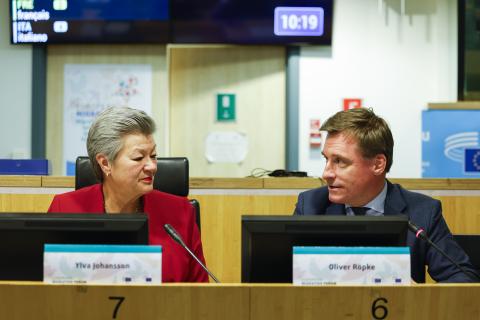
The 8th European Migration Forum (EMF), organised by the European Economic and Social Committee (EESC) and the Directorate-General for Migration and Home Affairs, explored questions around migrants' vulnerabilities, bridging the skills gap and countering prejudice surrounding migration.
A key point in the discussions was how to ease legal pathways to attract much-needed talent. In the face of Europe's growing labour shortage, the European Commission has just unveiled the Mobility Toolbox, a toolkit designed to facilitate the integration of third country nationals into the workforce. With 3.5 million migrants arriving legally in the EU last year, 1.2 million specifically for labour purposes, effective integration strategies will be of crucial importance.
The EU Commissioner for Home Affairs, Ylva Johansson, provided updates on critical policy initiatives and the current state of affairs in Europe. Never underestimate the skills and potential that migrants bring", she emphasised. "Integration is not about assimilating into a country; it's about becoming part of a community. And that's where civil society plays a pivotal role.
While the Mobility Toolbox marks a positive step forward, participants in the forum called for a more comprehensive approach. This includes streamlined recognition processes for foreign qualifications, access to language courses, and vocational training at both national and regional levels.
The President of the EESC, Oliver Röpke, remarked I pledged in my manifesto to 'stand up for democracy', which at its core is all about values of freedom, tolerance, equality, and respect. The narratives around migration must be grounded in these values to fight disinformation.
The EESC has already taken concrete action on critical themes related to the EMF, advocating the protection of unaccompanied migrant minors, pushing for a revision of the anti-trafficking directive, and implementing measures to improve mental health. President Röpke underscored the role of civil society in shaping inclusive migration policies, positioning the EESC as a vital link between citizens and EU institutions.
Fostering a welcoming and supportive environment for migrants is essential to their successful integration into the labour market. This involves combating discrimination and xenophobia, promoting intercultural understanding, and ensuring access to essential services such as housing and healthcare.
Work organisation
Recommended for you
Decision repealing Directive 89/629/EEC
Opinion
PUNTOS CLAVE El CESE: Considerando que el contenido de la propuesta es satisfactorio y no es objeto de ninguna observación por su parte, decidió emitir un dictamen favorable sobre la propuesta.
La UE necesita más inversión pública en infraestructuras energéticas para luchar contra el cambio climático
News
En un Dictamen aprobado en el pleno de septiembre, el Comité Económico y Social Europeo (CESE) afirma que se necesita una inversión pública masiva para lograr la transición energética y cumplir los…
Energía: el CESE advierte contra la creación de nuevas dependencias
News
El Comité Económico y Social Europeo (CESE) se pronuncia con firmeza sobre la energía en un Dictamen aprobado en su pleno de septiembre: la propuesta de la Comisión es un paso en la dirección…
La transición digital debe ser justa: los derechos humanos y el control humano deben seguir teniendo una importancia fundamental
News
El Comité Económico y Social Europeo (CESE) señala las oportunidades que presenta la revolución digital, pero también advierte de sus peligros: si se implantan con demasiada rapidez, las soluciones…
La UE necesita ya un plan de acción para ofrecer una vivienda asequible y digna
News
En la conferencia de alto nivel que el Comité Económico y Social Europeo (CESE) celebró en Riga los participantes dieron la voz de alarma por la crisis de la vivienda asequible y advirtieron que ya…