
European Economic
and Social Committee
Meet the new European Environment Agency’s Executive Director, Leena Ylä-Mononen
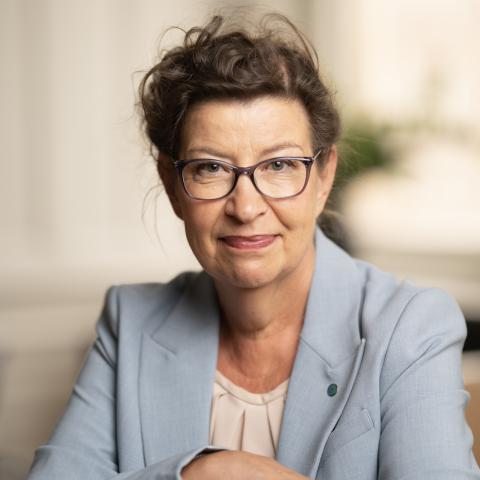
Ms. Leena Ylä-Mononen holds a Master’s degree in environmental sciences in the Helsinki University, specialising in ecotoxicology and chemicals risk assessment and management and has worked with national, European, and international environmental policy and administration for over 30 years. Before joining the European Environment Agency, she was Director General at the Ministry of the Environment of Finland.
As a new Executive Director, what is your vision for the EEA in the coming years?
My focus is to take the EEA’s work forward in this pivotal time. In Europe as well as globally, decisive action is needed to limit and to adapt to climate change, halt biodiversity loss and stop pollution.
The EEA has a big responsibility and role to play to ensure our policymakers have the knowledge and data required to make the right decisions in the years ahead and to ensure the measures we take facilitate a just transition.
For me a key priority is to better engage with citizens, business and other civil society actors and providing them with relevant information on the state and pressures of the environment. This is the way to make sure all parts of our society feel included in the huge changes that are required in our shift to a sustainable future. All actors must be able to play a role and know there are positive outcomes to Europe’s shift to a sustainable future.
How is the EEA helping to advance the European Green Deal?
The EEA has played an important role already in the development of the European Green Deal. Our last European Environment State and Outlook (SOER) report in 2020 underpinned the key elements of this transformative legislative package.
Moving forward, we will continue to support the Green Deal’s objectives and policy measures by providing policy makers and EU institutions data and information to monitor its progress. We are involved in many facets of the Green Deal and we do this through our unique European Environment Information and Observation Network (Eionet). Through its 38 member and cooperating countries, EEA and Eionet gather and develop data, knowledge, and advice to policy makers.
For example, on climate mitigation and adaptation, the EEA collects annual data on progress to the 2030 climate targets which are a stepping stone to our commitment to the Paris Agreement. It also includes information on projected emission reductions through 2050, which can be used to monitor climate progress. On adaptation, we are working on the first European Climate Risk Assessment. Its objective is to help identify adaptation-related policy priorities for the next policy cycle and to inform the further development of EU policies, including the European Green Deal, in climate-sensitive sectors. We do similar data assessments on a long list of water, nature and biodiversity policies to show progress to the objectives of these policies in the specific context of the Green Deal as well as the EU’s Biodiversity Strategy and the Zero-Pollution action plan. On this plan we deliver the monitoring and outlook report (in collaboration with the JRC) and we also work with the European Chemicals Agency on the preparation of the indicators for the Chemicals Strategy for Sustainability.
How do you see the role of civil society in collecting and disseminating knowledge and data to support Europe's environment and climate goals?
Civil society has a crucial role to play to both inform and support Europe’s environment and climate goals. Knowledge and data are key to our transition to a low-carbon and sustainable future and it is vital that this is shared amongst all key players in this huge endeavour to build understanding. More to the point, putting in place the European Green Deal requires a transformative agenda which must involve all parts of society and all actors. This includes cities and regions as well as national governments, industry and business, NGOs and citizens and especially youth.
A key element of this transformation is a just transition, where no one and no region are left behind and where existing inequalities in areas such as exposure to pollution and impacts of climate change are addressed so that the most vulnerable are protected. This is exactly where dialogue, building knowledge and best practices come into play.
Economies are shifting and many regions across Europe are becoming more and more vulnerable to climate change, making the green transition a much-needed priority. At the same time we are seeing increased uncertainty, anxiety in our society and even resistance to change in some communities.
So that is why I think better communication and dialogue is key. The EEA supports the idea of starting more structured dialogues like the Commission is doing on the future of agriculture, for example. We would be more than happy to contribute to the conversation with the knowledge that we develop.
And I am looking into expanding our Agency’s links to civil society, to business and industry groups, to citizens and other actors as well.
The Green Deal needs to be translated into a positive experience which includes all Europeans and progresses together so it better responds to the real needs of EU citizens.
Work organisation
Recommended for you
YEYS! 2023: Jongeren vragen een EU die transparanter, digitaler en eenvoudiger is
News
Op 23 en 24 maart is bij het Europees Economisch en Sociaal Comité (EESC) de veertiende editie van Jouw Europa, jouw mening! (YEYS!) gehouden. Voor dat evenement kwamen 105 leerlingen van 35 scholen…
De elektriciteitsmarkt van de EU moet worden hervormd
News
Uit een door het Europees Economisch en Sociaal Comité (EESC) georganiseerd debat kwam naar voren dat het van cruciaal belang is de Europese elektriciteitsmarkt aan te passen om de zwakke punten…
Kandidaten kunnen zich nu aanmelden voor de EESC-prijs voor het maatschappelijk middenveld, die dit jaar geestelijke gezondheid als thema heeft
News
Maatschappelijke organisaties, individuen en particuliere ondernemingen kunnen nu met hun non-profitprojecten meedingen naar de EESC-prijs voor het maatschappelijk middenveld, die deze keer in het…
EESC roept de EU-burgers op om in juni 2024 te stemmen voor een verenigd en democratisch Europa
News
Tegen de achtergrond van een wereldwijde achteruitgang van de democratie, welig tierende desinformatie, groeiende ontevredenheid, stijgende inflatie en oorlogsdreiging, staat er veel op het spel bij…
De sociale en burgerdialoog kunnen de EU helpen duurzaam te groeien
News
Slechts enkele dagen na de Europese verkiezingen van 2024 kwamen het Europees Economisch en Sociaal Comité (EESC) en de nationale sociaal-economische raden van de EU bijeen om de stand van zaken van…