
European Economic
and Social Committee
Annual conference of the Fundamental Rights and Rule of Law Group: time to go from recommendations to actions!
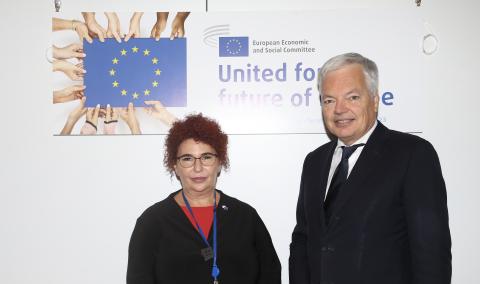
On 26 September, the European Economic and Social Committee (EESC) held a conference on the latest European Commission's Rule of Law Report. The event brought together civil society representatives and EU institutions to discuss key developments in the field of the rule of law in Europe and ways to ensure that the recommendations made in the EC's Report result in tangible improvements in Member States. It was also the opportunity to present the report synthetising the outcomes of the country visits carried out by the Fundamental Rights and Rule of Law Group in 2020-2021.
The annual conference of the EESC Fundamental Rights and Rule of Law (FRRL) Group provided a platform for debate of the European Commission's third Report on the Rule of Law, which for the first time entails country specific recommendations concerning the areas of justice, corruption, media, and checks and balances. The report presents the Commission’s own assessment and virtual visits to all 27 Member States, with input from national authorities, independent bodies and stakeholders. This year’s edition shows that progress has been uneven in the Union, and that serious concerns remain in a number of Member States.
What we have been confronting in the recent years is a real "rule of law crisis".
The EU should always use all its tools – including budget conditionality, as rightly done recently – to address any new attack on democracy, the rule of law, and human rights, as soon as they emerge, and anywhere they happen
stated EESC president Christa Schweng opening the conference. The 24th of February marked the start of a new chapter in our Union's history. A chapter where our democratic models are in danger. It would be a terrible mistake to believe that this fight between democracy and authoritarianism is only a challenge for our neighbours.
The European Commissioner for Justice, Didier Reynders, explained that This year has shown again that anchoring a strong rule of law culture in the EU is fundamental. As we work together to help Ukraine defend its sovereignty and integrity, we can only remain credible if we protect the rule of law inside the European Union as well. Promoting the rule of law is a common responsibility. All EU institutions, Member States, courts, legal practitioners, as well as civil society organisations, have a role to play in this context.
The conference was also an opportunity to present the EESC Fundamental Rights and Rule of Law (FRRL) Group's second synthesis report, providing an overview of the country visits organised by the FRRL group in Denmark, Germany, Ireland, Czech Republic, Spain, Cyprus and Lithuania in 2020 and 2021 to understand the perspective of civil society regarding current trends in the Member States on the rule of law and democracy. Civil society representatives at national level are calling for concrete actions from the EU, in terms of high-quality frameworks for civic space, funding, freedom of expression and media freedom, and discriminations. Cristian Pîrvulescu, President of the EESC FRRL Group, explained that While democratic systems in countries visited have generally shown a good level of resilience, the need for safeguards and effective checks and balances, including the role of watchdog played by civil society, has been clearer than ever.
Roundtable discussions covered the role of civil society in promoting the rule of law and follow-up to the recommendations of the EC Report. Panellists concurred that the Conference on the future of Europe was an important effort towards more meaningful participation of our citizens, however they agreed that discussions were too conceptual and broad to be able to measure clear results of the exercise. Future attempts at citizens panels should involve more concrete and pointed objectives. Similar suggestions were made regarding country specific recommendations in the EC Rule of Law Reports: participants found that they should be more detailed, with clear timelines and benchmarks. The panel also called for stronger involvement of civil society in the follow up process of these recommendations.
In her closing remarks, Edita Hrdá, Ambassador of the Permanent Representative of the Czech Republic to the EU, emphasized the importance of civil society: The history of the Czech Republic, particularly with the so-called Velvet Revolution, has taught us that representatives of civil society are capable of bringing about fundamental changes. They bring life to human rights. Striving to further promote the Rule of Law is an ever-lasting task that requires not only our cooperation, but also constant vigilance.
A summary of the discussions and the recording of the conference will be made available on the EESC website shortly.
Work organisation
Recommended for you
YEYS! 2023: Jongeren vragen een EU die transparanter, digitaler en eenvoudiger is
News
Op 23 en 24 maart is bij het Europees Economisch en Sociaal Comité (EESC) de veertiende editie van Jouw Europa, jouw mening! (YEYS!) gehouden. Voor dat evenement kwamen 105 leerlingen van 35 scholen…
De elektriciteitsmarkt van de EU moet worden hervormd
News
Uit een door het Europees Economisch en Sociaal Comité (EESC) georganiseerd debat kwam naar voren dat het van cruciaal belang is de Europese elektriciteitsmarkt aan te passen om de zwakke punten…
Kandidaten kunnen zich nu aanmelden voor de EESC-prijs voor het maatschappelijk middenveld, die dit jaar geestelijke gezondheid als thema heeft
News
Maatschappelijke organisaties, individuen en particuliere ondernemingen kunnen nu met hun non-profitprojecten meedingen naar de EESC-prijs voor het maatschappelijk middenveld, die deze keer in het…
EESC roept de EU-burgers op om in juni 2024 te stemmen voor een verenigd en democratisch Europa
News
Tegen de achtergrond van een wereldwijde achteruitgang van de democratie, welig tierende desinformatie, groeiende ontevredenheid, stijgende inflatie en oorlogsdreiging, staat er veel op het spel bij…
De sociale en burgerdialoog kunnen de EU helpen duurzaam te groeien
News
Slechts enkele dagen na de Europese verkiezingen van 2024 kwamen het Europees Economisch en Sociaal Comité (EESC) en de nationale sociaal-economische raden van de EU bijeen om de stand van zaken van…