European Economic
and Social Committee
European Economic
and Social Committee
The European Economic and Social Committee (EESC) is the voice of organised civil society in Europe.
Find out more about its role and structure at http://www.eesc.europa.eu/en/about
The EESC issues between 160 and 190 opinions, evaluation and information reports a year.
It also organises several annual initiatives and events with a focus on civil society and citizens’ participation such as the Civil Society Prize, the Civil Society Days, the Your Europe, Your Say youth plenary and the ECI Day.
Find the latest EESC opinions and publications at http://www.eesc.europa.eu/en/our-work/opinions-information-reports/opinions and http://www.eesc.europa.eu/en/our-work/publications-other-work/publications respectively.
The EESC is active in a wide range of areas, from social affairs to economy, energy and sustainability.
Learn more about our policy areas and policy highlights at http://www.eesc.europa.eu/en/policies
The EESC holds nine plenary sessions per year. It also organises many conferences, public hearings and high-level debates related to its work.
Find out more about our upcoming events at http://www.eesc.europa.eu/en/agenda/our-events/upcoming-events
Here you can find news and information about the EESC'swork, including its social media accounts, the EESC Info newsletter, photo galleries and videos.
Read the latest EESC news http://www.eesc.europa.eu/en/news-media/news and press releases http://www.eesc.europa.eu/en/news-media/press-releases
The EESC brings together representatives from all areas of organised civil society, who give their independent advice on EU policies and legislation. The EESC's326 Members are organised into three groups: Employers, Workers and Various Interests.
Find out more about our Members and groups at http://www.eesc.europa.eu/en/members-groups
The EESC has six sections, specialising in concrete topics of relevance to the citizens of the European Union, ranging from social to economic affairs, energy, environment, external relations or the internal market.
Find out more at http://www.eesc.europa.eu/en/sections-other-bodies
Civil society organisations express disappointment at the outcomes of COP28, but view them as a platform for increased European action on the global stage. The European Economic and Social Committee (EESC) remains committed to addressing the climate crisis, emphasisng the need for greater ambition and youth involvement.
COP28 marks a historic shift as countries commit to transitioning away from fossil fuels in energy systems for the first time in thirty years. EESC President Oliver Röpke acknowledges this progress but insists on a complete fossil fuel phase-out and stresses the importance of engaging young people in these efforts.
European Union negotiators claim success in keeping alive the Paris Agreement's goal of limiting the global temperature increase. COP28 focuses on the energy sector, targeting a 43% emissions reduction by 2030 and aiming for net-zero emissions by 2050. However, the agreement is the target of criticism due to its shortcomings, including uncertainties about meeting the 1.5°C target, influence from petro-states and weak financial provisions for the transition.
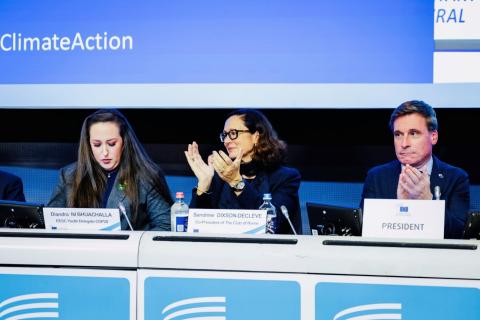
Sandrine Dixson-Declève, Co-President of The Club of Rome, warns of increasing wealth inequality and social tensions resulting from inadequate burden-sharing. EESC Youth delegate Diandra Ni Bhuachalla says she is devastated by COP28's outcome, emphasising the importance of real people's experiences in countering fossil fuel lobbyists.
Despite concerns, EESC members recognise positive aspects of the Dubai agreement and pledge to address loopholes, while urging other EU institutions to do the same. The overarching message from the EESC debate is a resolute commitment: "We will not give up" on urgently tackling the climate crisis through continued EU and UN action. (ks)