
European Economic
and Social Committee
Ukraine will be free and become a fully-fledged EU Member State
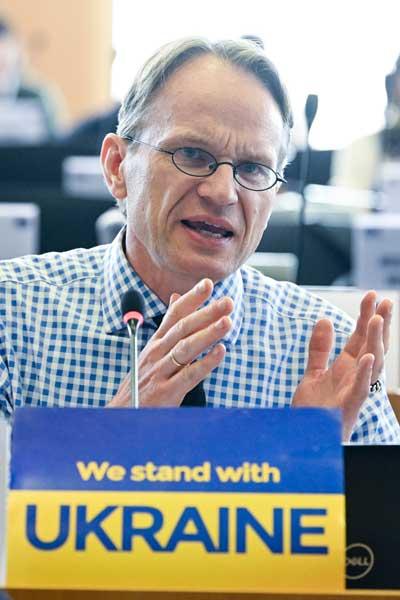
In today’s turbulent times, including those in US policy, that title might sound somewhat strange, but in fact Ukraine’s candidacy for EU membership is an opportunity for – and obligation on – us in the EU to grasp, if we ourselves do not want to experience severe suffering like the people living in Ukraine. Immediate stronger commitment from the EU to support Ukraine would benefit everyone, and Ukraine’s membership of the EU would make the EU safer and stronger.
The full-scale war of aggression against Ukraine is coming into its fourth year. Shame on the democratic world for not having managed to stop the war against not only our neighbour but also the entire rules-based order! Civil society colleagues in Ukraine are clear that the priority remains to deliver all the weapons they need, but another one is to close the loopholes that allow sanctions on Russia to be circumvented and to stop all other direct and indirect support for Russia and its war.
In the meantime, no one doubts that Ukraine’s path towards the EU is irreversible. The work it has carried out so far is admirable, and preparations for accession talks are already under way. Civil society organisations (CSOs) in Ukraine have for decades been the driving force behind – and a watchdog for – EU integration, and the EESC has pioneered the involvement of CSOs representatives in EU policy-making through its ‘Enlargement Candidate Members’ Initiative (ECM)1, its EU-Ukraine Civil Society Platform2 and its EU-Ukraine Domestic Advisory Group3. However, the EESC’s cooperation with Ukrainian CSOs goes even further, including the provision of office space for Ukrainian CSOs, and targeted projects by EESC Members and their organisations, amongst other things.
It is now crucial to create a properly resourced secretariat for CSOs involvement and coordination and to create structures for dialogue, needed to ensure that the decisions taken in Ukraine in the run-up to accession and afterwards are the right ones and the most effective. What will be the best way ahead for Ukraine? How can we ensure that CSOs are heard and involved? This has been discussed intensively at the EESC’s EU-Ukraine Civil Society Platform meetings, where representatives from the EESC’s Civil Society Organisations’ Group have played a leading role. One key conclusion: the existing EU-Ukraine Civil Society Platform is an excellent starting point for future development, but a great deal of –sometimes hard – work will have to be done.
In a recent meeting, the European External Action Service4 stated that it would investigate the legal aspects of involving civil society as widely as possible in negotiations on the particular chapters it is coordinating.
The European Commission’s Directorate-General for Neighbourhood and Enlargement Negotiations (DG NEAR)5, which is coordinating the accession negotiations as a whole, will be checking the possibilities for providing resources for CSOs’ coordination work and other involvement during the accession process. The Mission of Ukraine to the European Union6 (Ukrainian representation in Brussels) has undertaken to report to the Ukrainian Ministry of Foreign Affairs that a request for funding should be tabled to make the allocation of funds faster and more realistic.
The EU as a whole –and we as civil society – can and must do more, faster and better. Nice words of support are no help to any victim who has been attacked. I am proud that the EESC, and especially the representatives of the Civil Society Organisations’ Group, have played a key role in working for a better and more united Europe, based on International Law and the Rule of Law. I would like to remind us all of the very precise request in the EESC Resolution on the war in Ukraine and its economic, social and environmental impact7 issued in the month following the outbreak of the full-scale war: “The EESC believes it is of the utmost importance to the EU and the international community that no borders be changed through military means, and that no benefits be gained by the aggressor. The rule of law must be upheld, not the rights of the strongest, and full reparations paid to Ukraine”.
Examples of the specific needs of civil society organisations (CSOs) and their involvement in Ukraine’s EU accession process, as discussed in the EU-Ukraine Civil Society Platform:
- Including Ukrainian civil society in CSOs umbrella networks at EU level and creating joint projects
- Supporting coordination among organisations and their experts in Ukraine and setting up a secretariat for coordinating CSOs participation and involvement in accession negotiations and beyond
- Finding ways of providing the most effective financial support and further strengthening the capacity of CSOs in Ukraine and their networking with EU networks
- Creating CSOs participation and dialogue structures, needed for making the right decisions and the most effective ones in Ukraine in the run-up to accession and beyond. (Several EU Member States have civil dialogue bodies inspired by the EESC.)
- Opening doors to the accession negotiations from the EU side by ensuring broad CSOs and other stakeholder involvement from the Ukrainian side.
- EESC Enlargement Candidate Members (ECM) initiative, https://europa.eu/!J9MjPm
- EESC, EU-Ukraine Civil Society Platform, https://europa.eu/!WtNVY4
- EESC, EU-Ukraine Domestic Advisory Group, https://europa.eu/!HrRGgW
- EEAS, European External Action Service, https://www.eeas.europa.eu/_en
- European Commission, DG NEAR Guidelines for EU Support to Civil Society in the Enlargement Region 2021-2027, https://europa.eu/!9dYCt7
- Mission of Ukraine to the European Union, https://ukraine-eu.mfa.gov.ua/en
- EESC, Resolution on the war in Ukraine and its economic, social and environmental impact, March 2022, https://europa.eu/!cnMTNM