
European Economic
and Social Committee
EESC President
President Röpke reinforces the role of social dialogue during high-level mission to Montenegro
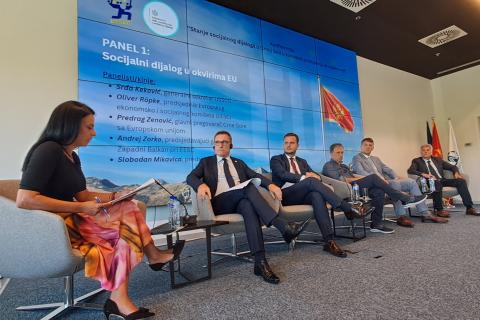
EESC President Röpke carried out a high-level mission to Montenegro on 1 September 2025, where he took part in the national conference “The State of Social Dialogue in Montenegro in the Context of European Union Accession”, organised by the Union of Free Trade Unions of Montenegro (UFTUM) with the support of the Solidarity Center.
The visit reaffirmed the EESC’s longstanding commitment to strengthening social dialogue and civil society participation as core pillars of the EU enlargement process. President Röpke joined the opening panel alongside UFTUM Secretary General Keković, Chief EU Negotiator Zenović, EESC Western Balkans Group Chair Zorko, and Employers’ Federation President Mikavica. The discussion focused on aligning Montenegro’s social dialogue with European standards and ensuring social partners are fully involved in shaping the country’s reform path.
Earlier in the day, President Röpke appeared live on Montenegro’s national broadcaster RTCG, underlining the need for fair working conditions, inclusive governance, and robust democratic institutions. He welcomed the European Commission’s recent disbursement of the first Growth Plan tranche to Montenegro, calling it a clear signal that reform efforts are delivering results. However, he stressed that future support must be tied to meaningful civil society involvement and reinforced social partnership.
During the visit, President Röpke also had a brief exchange with Minister of Labour and Social Welfare Naida Nišić, underlining the importance of strong political commitment to inclusive dialogue structures.
Throughout the mission, President Röpke highlighted the importance of the EESC’s Enlargement Candidate Members (ECM) initiative, which allows representatives from Montenegro and other candidate countries to actively participate in the EESC’s advisory work. Montenegrin ECMs have already contributed to EU-level opinions on skills shortages, youth dialogue, and cohesion policy.
“Montenegro has made important strides on its EU path, but lasting progress depends on inclusive reform, not just legal alignment,” said Röpke. “Social dialogue is not a formality — it is a foundation for trust, stability and shared responsibility. The EESC stands ready to support Montenegro in making it real.”
The conference concluded with a strong call for strengthening the institutional role of Montenegro’s Social Council and for better integration between tripartite dialogue outcomes and parliamentary decision-making. The EESC will continue to work with all partners in the region to ensure that enlargement remains a democratic, inclusive and people-centred process.

Contact
Séamus BOLAND
European Economic and Social Committee
rue Belliard/Belliardstraat 99-101 1040 Brussels Belgium
Tel (secretariat): +32 (0)2 546 97 25 - Email (secretariat)
Media Contact
For press and media inquiries, please contact the President's Spokesperson