On 23 September, the European Commission announced the winners of the third edition of the EU Organic Awards. The European Economic and Social Committee (EESC) proudly welcomed the winners of three key categories: Best organic food processing SME, Best organic food retailer, and Best organic restaurant/food fervice.
The European Economic and Social Committee (EESC) and the African Union Economic, Social and Cultural Council (ECOSOCC) today presented a Joint Declaration at the UN Summit of the Future in New York, emphasising the crucial role of civil society in addressing global challenges and advancing sustainable development.
In its effort to lead global climate action, the European Union should set an ambitious target for 2040, aiming to reduce net greenhouse gas emissions by 90%, in line with its broader goal of achieving climate neutrality by 2050. This target, endorsed by the European Economic and Social Committee (EESC) at its September plenary session, aligns with the scientific consensus on the need to limit global warming to 1.5°C.
Η Ευρωπαϊκή Οικονομική και Κοινωνική Επιτροπή (ΕΟΚΕ) ενέκρινε ψήφισμα με το οποίο καταγράφει την πρόοδο που έχει σημειωθεί στην Ευρωπαϊκή Ένωση όσον αφορά τη δημοκρατία και στο οποίο ζητεί μια ισχυρότερη ΕΕ με βάση μια εξαπλή έννοια της ασφάλειας.
The names of the finalists for the 2024 EU Organic Awards have been revealed today. For each of the eight categories, the top three projects have been selected, representing 24 finalists from 12 EU countries. The winners of the eight awards will be unveiled at the official ceremony in Brussels on 23 September, as part of a series of events and activities celebrating the annual EU Organic Day.
On 17 July, the President of the European Economic and Social Committee (EESC), Oliver Röpke, signed a Memorandum of Understanding (MoU) with the African Union Economic, Social and Cultural Council (ECOSOCC) represented by its Presiding Officer, Khalid Boudali. The memorandum aims to formalise the partnership between the two institutions and enhance economic and social stakeholder involvement in the Africa-EU partnership.
The European Economic and Social Committee (EESC) is calling for the Commission's proposal on making EU traineeships fairer and more inclusive to be reinforced. Nearly half of the EU’s more than three million trainees are unpaid and almost a third have no access to social protection. All young people should have the chance to benefit from the traineeship experience - not just those who can afford it
The European Economic and Social Committee (EESC) adopted a resolution during its July plenary session rejecting the idea of transforming cohesion policy into a mechanism similar to the Recovery and Resilience Facility (RRF). The EESC calls for cohesion policy to be strengthened and for civil society to be involved, just as it was for the 2021-2027 programming period.
The European elections proved that the pro-European majority still holds, but also showed that voters across the EU demand urgent political and legislative responses to the challenges raised in the electoral campaign. Otherwise, the pro-European majority may risk losing support as citizens may increasingly turn their backs on the mainstream political forces.
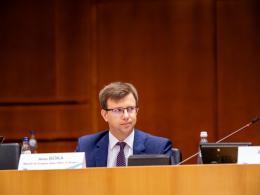
At the July plenary session of the European Economic and Social Committee (EESC), Committee president Oliver Röpke hosted a debate with the Hungarian Minister for European Union Affairs,János Bóka, who presented the main priorities of the Hungarian Presidency of the Council of the EU.