
European Economic
and Social Committee
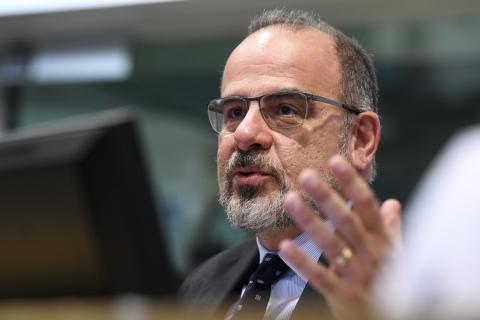
The European Economic and Social Committee (EESC) adopted its opinion on the next Multiannual Financial Framework (MFF) 2028-2034 in January 2026, delivering a clear message to the EU institutions: Europe’s strategic, social and geopolitical ambitions require a stronger and better-designed long-term budget. Read the interview with Luca Jahier, the EESC rapporteur from the Committee's Civil Society Organisations' Group.
By the Civil Society Organisations' Group
What are the main findings and recommendations of this opinion?
The EESC’s first key finding concerns the overall volume of the MFF. While acknowledging the European Commission’s proposed nominal increase, the Committee stresses that, once inflation and the repayment of NextGenerationEU debt are taken into account, real resources would remain largely unchanged. This falls short of what is needed to close persistent investment gaps in strategic autonomy, competitiveness, social cohesion, climate action, security and defence. Drawing on recent institutional reports, the EESC calls for a substantial increase in real resources relative to gross national income and for stronger EU-level investment in European public goods, which cannot be delivered effectively by Member States alone.
A second major concern relates to the structure and governance of EU funding. The EESC strongly opposes the proposed reductions to cohesion policy and the Common Agricultural Policy, underlining their proven contribution to economic, social and territorial convergence. It also raises serious reservations about the planned merger of several major policy areas into a single National and Regional Partnership Plan, as is currently proposed, warning that this risks excessive centralisation and weaker stakeholder involvement. The Committee therefore calls for a reinforced partnership principle, mandatory participation mechanisms, adequate support for capacity-building and safeguards where effective involvement is lacking.
The opinion also addresses revenues, competitiveness and democratic resilience. While welcoming the introduction of new EU own resources, the EESC calls for greater ambition and closer alignment with EU policy objectives. It supports EU emissions trading system ETS- and Carbon Border Adjustment Mechanism CBAM-based revenues, subject to transitional support for energy-intensive sectors, but expresses strong reservations about the proposed Corporate Resource for Europe, recommending instead the reintroduction of a digital services tax.
On competitiveness, the Committee stresses that this must go hand-in-hand with social fairness, equal access to funding and substantial investment in research, innovation, skills and infrastructure. Adequate financing for civil society and media programmes is highlighted as essential democratic infrastructure.
Finally, the EESC welcomes the reinforced Global Europe pillar, stressing that increased funding for external action must support strategic autonomy, enlargement and neighbourhood stability, while strengthening the Global Gateway as a coherent instrument for multilateral engagement.
After the adoption of this opinion, what will you do to promote it?
Following the adoption of the opinion, the EESC will actively promote its recommendations through dialogue with the European Commission, the European Parliament, the Council and key stakeholders, ensuring that organised civil society contributes meaningfully to the negotiations on the EU’s next long-term budget.