The event will present a grassroots and local government perspective on the European Green Deal, with ECOLISE and ICLEI Europe sharing insights into the handprint of community-led initiatives and local governments in addressing the planetary crisis.
The Domestic Advisory Groups (DAGs), set up under the EU-UK Trade and Cooperation Agreement (TCA) to advise on the implementation of the agreement, held their second meeting on 6 November 2023, in London.
On 6 November 2023, the EESC will host a public hearing in the context of its ongoing opinion on 'Promoting autonomous and sustainable food production: strategies for the Common Agricultural Policy (CAP) post-2027' requested by the upcoming Belgian Presidency of the Council of the EU.
The EESC participates in the important event on labour, organized by the European Commission (DG EMPL). The Conference creates an opportunity to exchange views on how to strengthen compliance with labour rights and promote decent working conditions, with a particular focus on freedom of association, combating informality at work in rural areas and eradicating child labour.
26 October 2023 | Charlemagne Building | Room GASP
Brussels
Belgium
On 26 October 2023, the European Economic and Social Committee (EESC) will adopt its call for a new and comprehensive water strategy for Europe – an EU Blue Deal. The high-level conference will be an occasion to exchange with water experts, key stakeholders and representatives of other EU institutions on the need to establish water as one of the strategic priorities for the European Union for the next years to come.
Europe, water you waiting for? – EESC plenary to issue call for an EU Blue Deal
-
Event type
Plenary Session
Location
Brussels
Belgium
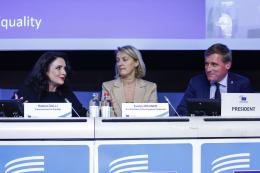
582nd plenary session, with the following guests: Evelyn Regner, Vice-President of the European Parliament and Helena Dalli, European Commissioner for Equality, Pernille Weiss, Member of the European Parliament, Chair of the MEP Water Group. Web streaming
Room JDE 62 EESC building, Rue Belliard 99, 1040 Brussels and Interactio
Brussels
Belgium
The EESC's Permanent Group on disability Rights is organising a hybrid public hearing on "The Web accessibility directive: looking forward" on 23 October 2023 from 9:30 am to 1 pm.
The aim of the Web Accessibility Directive is to provide people with disabilities with better access to public websites and mobile apps.
In the hearing, stakeholders will look at the main challenges hindering a full application of the directive and discuss which would be the necessary next steps to take in this field to ensure full digital accessibility within the EU
20 October 2023 | 10:00 - 13:00 | JDE Building | Room JDE63
Brussels
Belgium
The purpose of this hearing was to contribute to the EESC opinion and to the debate on the rethinking of the internal market in light of the acceleration of the twin transitions and on crafting a European Industrial Strategy that strenghen EU industries.