
European Economic
and Social Committee
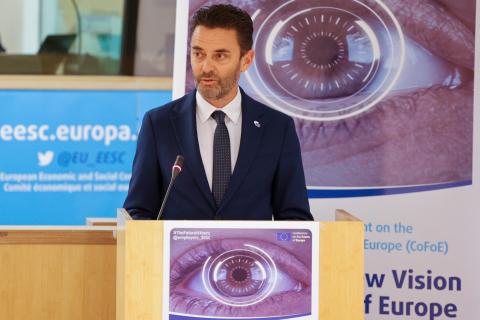
Speech by President Mallia at EESC Employers' Group event "Setting out a New Vision for the Future of Europe"
Dear President Rompuy,
Dear President Schweng,
Dear Dr Tataj,
Distinguished guests,
Ladies and gentlemen,
It is a pleasure and honour for me to welcome you today to our Group event organised in the framework of the Conference on the Future of Europe - "Setting out a New Vision for the Future of Europe".
For those who don't know us yet, the Employers’ Group is the body within the European Economic and Social Committee representing more than 20 million European companies – big and small – that form the backbone of our European economies and societal welfare.
Our members are active in the business world and bring the day to day reality of business from all EU Member States to the European level.
We work in close cooperation with our Partner organisations to promote and defend the interests of the European enterprises. I am pleased they are all here with us today (Business Europe, SMEunited, SGI Europe, Copa-Cogeca, Eurochambres, Eurocommerce).
Today, we are launching our Group Manifesto for the Future of Europe "Making the EU Capable of Action"– a paper that embodies our views on the Europe we want in the coming decades.
So, what is the Europe we dream of?
First and foremost, it's a strong and more competitive Europe – a Europe that leads the world in the green and digital transitions while maintaining and enhancing prosperity for present and future generations.
Dear colleagues of the Employers Group, you all know my thoughts on this - whilst the pandemic has put before us unimaginable challenges it is climate change which will be the real challenge that will define us in the years and decades to come…………and we must meet this challenge head on!!
And as we move from crisis into recovery, from protecting our health and safeguarding our economy to embracing new opportunities ahead of us – we need to be well prepared and equip ourselves with the right tools to put Europe on a strong, positive path in which freedom, creativity and entrepreneurship can thrive.
Dear colleagues, distinguished guests,
Sometimes, with so much emphasis on the future, it is also worth looking a bit at our past and the concrete achievements behind us.
When we initiate new common projects in Europe (such as the initiative we have before us now), I believe that they should adhere to the same principles that brought success almost 70 years ago:
- they must be based on a consensus that action is truly necessary;
- they should complement the actions of governments;
- they should be clearly linked to people’s most pressing concerns;
- they should focus on matters of European or global significance.
If these principles are applied, there are many areas in which Europe does not need to get involved. But there are also important areas where it must take new initiatives, which are not just legitimate, but essential.
And where responses can only be provided at the supranational level, we should focus on those actions that deliver tangible and recognisable results. And here I would list 4 main actions:
First: To allow citizens, companies and countries the freedom to trade and create prosperity, one of our main tasks should be the completion of our Single Market.
Second: Europe needs to protect global trade rules, ensure a level playing field and strike the balance between strategic autonomy and openness to international trade. That is done by promoting a strong industrial base and resilient international supply chains.
It is important to ensure Europe’s technological sovereignty in strategically important sectors. Research and innovation activities need to be stepped up in key enabling technologies, such as artificial intelligence, micro- and nanotechnology, photonics, quantum technology, new materials, biotechnology and energy and mobility technology (e.g. hydrogen).
Third: It is important for the EU to play an active role in international climate policy. We strongly support the Paris agreement and a forward-looking climate policy, but we strongly believe that this needs to be coupled with industrial competitiveness and reliable framework conditions.
Climate targets have to be realistic and must be reached without undermining European competitiveness.
For us, all EU initiatives should undergo a “competitiveness check” to assess their impact on companies as regards the cost of doing business, on their capacity to innovate and on their international competitiveness.
We ask for this not out of some sense of self-importance but because we follow the logic that it is companies which create wealth which can then be invested in new green technologies whilst at the same time taking care of the most vulnerable.
Last but not least, if we accept the fact that the EU will remain in a "permanent crisis", we cannot operate in the current rigid legal governance approach.
For the Union to be able to exercise its powers when confronted with crises, we need to devise more effective steering instruments that are flexible, agile, and simply faster, not only to allow the European Union to survive, but also to act powerfully and effectively in the global arena.
Ladies and gentlemen,
The institutions have created a structure that is called ‘The Conference on the Future of Europe’. This is but a vehicle that is meant to serve a purpose - that of mapping out a future path. My appeal to you is – let us not be conditioned by the limitations of the vehicle. Let us keep a strong open mind that does not fear doing whatever it takes to forge a long-lasting and sustainable change in the EU, so that at the end we can truly have an EU that is capable of taking meaningful action.
Thank you for your attention!
Employers' Group President Stefano Mallia delivered this speech at the Employers' Group event on the Conference on the Future of Europe "Setting out a New Vision for the Future of Europe" which took place on 10 December 2021.
Work organisation
Recommended for you
Pro odolnost EU má zásadní význam aktivní úloha organizované občanské společnosti
News
Na plenárním zasedání EHSV se diskutovalo o tom, jak roste význam organizované občanské společnosti a měst, neboť ovlivňují schopnost Evropy čelit asymetrickým otřesům a neočekávaným…
Mladí lidé coby hybatelé změn a evropské integrace zemí západního Balkánu
News
V rámci konference občanské společnosti na vysoké úrovni na téma Politika v oblasti mládeže v zemích západního Balkánu, kterou uspořádal Evropský hospodářský a sociální výbor (EHSV),…
České předsednictví chce dát Evropě nové pojetí, novou podobu a nový impuls
News
Jedním z bodů červencového plenárního zasedání Evropského hospodářského a sociálního výboru (EHSV) byla diskuse s českým ministrem zahraničních věcí Janem Lipavským o…
Vaše Evropa, váš názor (YEYS!) 2023: Mladí lidé požadují transparentnější, digitálnější a zjednodušenou EU
News
Evropský hospodářský a sociální výbor (EHSV) uspořádal ve dnech 23. a 24. března 14. ročník akce Vaše Evropa, váš názor (YEYS!). V jejím rámci se v Bruselu sešlo 105 studentů z 35 škol ze všech 27…
Spravedlivý přechod na nízkouhlíkovou společnost není možný bez účasti občanské společnosti
News
Dolní Vítkovice v Ostravě jsou bývalou průmyslovou oblastí, kde se dříve těžilo uhlí a vyráběla ocel. 11. října 2022 se zde na konferenci sešli zástupci akademické obce, místních…