
European Economic
and Social Committee
The EU must truly empower towns and regions to make decarbonisation a reality
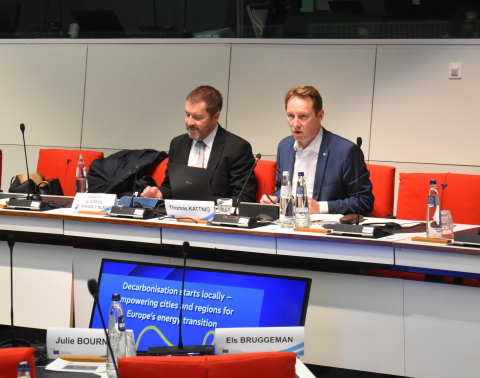
‘Decarbonisation starts at local level’ was the main takeaway from a conference held by the EESC’s Section for Transport, Energy, Infrastructure and the Information Society (TEN). Towns and regions must be given the appropriate means to step up the EU’s energy transition and ensure energy security and local energy autonomy.
The European Economic and Social Committee (EESC) stresses that the EU can only achieve its climate neutrality goals by enabling local actors to turn climate ambitions into action on the ground. At a conference held in Brussels on 27 October 2026, participants underlined that municipal and regional authorities have a key role in driving the energy transition.
On the one hand, cities are responsible for the majority of greenhouse gas emissions. On the other, local authorities are responsible for implementing most climate adaptation measures. It is therefore essential that the EU empower local authorities if it wants to achieve its climate neutrality objectives and increase its strategic energy autonomy.
The event, entitled ‘Decarbonisation starts locally – empowering cities and regions for Europe’s energy transition’, brought together people representing the European Commission, local authorities, trade unions, civil society and the clean energy sector, and put forward practical pathways towards an affordable and community-driven clean energy transition.
Highlighting that the energy transition would only be successful if people saw it as an opportunity to have clean, more secure and affordable energy and not as an additional burden, Thomas Kattnig, president of the EESC’s Permanent Group on Energy, said: ‘The energy transition will not be decided just in Brussels, it will be decided in our towns and our regions. Cities and regions are the backbone of our energy transition. The green transition will only succeed if it is underpinned by the right regulatory framework, financing and high-quality jobs.’
Towns and regions are part of the solution
Cities are responsible for 71–76% of global greenhouse gas emissions. This means that they are part of the cause of the problem, but they can also be part of the solution. While the EU and national governments set strategic direction, local and regional authorities, together with their citizens, are responsible for implementing 90% of the EU’s climate adaptation policies on the ground.
The energy transition must be put in place in a way that is closer to households and businesses on the ground, focusing on both urban energy supply management and the shift to active energy consumers. Together, these actions reinforce security of supply, reduce energy prices and bolster local energy autonomy.
‘Europe’s clean energy future starts in our communities, where local and regional leaders empower citizens to turn renewable energy into shared prosperity, lower bills and greater resilience,’ added the European Commission’s Alejandro Ulzurrun de Asanza y Muñoz, responsible for Just Transition, Consumers, Energy Efficiency and Innovation.
Towards an affordable and community-driven clean energy transition
The conference made clear that it was possible to build local energy sovereignty through decentralised renewable energy systems, smart grids, energy storage and innovative clean technologies.
Decentralised energy systems are becoming a cornerstone of resilient and sustainable cities. Local authorities can accelerate the deployment of locally managed renewable energy sources, including solar, wind and geothermal energy and heat pumps. Emerging solutions also have an important role to play. Biofuels, hydrogen and waste-to-value technologies, alongside smart grids, energy storage and district energy systems, can strengthen local energy security, reduce emissions and bring energy production closer to consumers.
The top priority must be to make a community-driven, affordable clean transition a reality. To reach this objective, citizens need to be empowered as active participants in the energy transition through inclusive governance, community ownership and affordable clean energy solutions.
The clean energy transition can only succeed if citizens are active participants rather than passive consumers. Cities can foster social acceptance, strengthen community ownership of renewable energy projects and empower consumers through innovative governance and financing models. Local initiatives can make clean energy affordable, inclusive and beneficial for communities, reinforcing energy citizenship and ensuring that the transition brings about concrete social and economic value for local communities.
Other quotes
‘The European Union cannot, on the one hand, draw up ambitious climate strategies in Brussels, while on the other tying the hands of local authorities with complicated procedures and debt limits. If cities are to implement 70% of the EU’s climate mitigation measures, then the energy transformation must cease to be a financial burden for us and instead become a catalyst for development.’
Hanna Zdanowska, Mayor of Łódź and member of the European Committee of the Regions
‘Possible pushback from citizens is something we have to address. How much land do we need for self-sufficiency for renewables? Roughly 90% of renewable energy capacity is located in rural areas. We only win local support by having local citizens participate and share the benefits.’
Davide Sabbadin, Policy Manager, European Environmental Bureau (EEB)
‘Energy is an essential service for everybody. Nobody can live without heating, light or power. Energy cannot be treated as a simple commodity or a financial asset designed to give stable returns to investors. The point is not how much we invest, but who will make the decisions, who will carry the risks and who will benefit.’
Pauline Dulongcourty, Policy Officer for utilities, European Federation of Public Service Unions (EPSU)
Work organisation
Recommended for you
Pro odolnost EU má zásadní význam aktivní úloha organizované občanské společnosti
News
Na plenárním zasedání EHSV se diskutovalo o tom, jak roste význam organizované občanské společnosti a měst, neboť ovlivňují schopnost Evropy čelit asymetrickým otřesům a neočekávaným…
Mladí lidé coby hybatelé změn a evropské integrace zemí západního Balkánu
News
V rámci konference občanské společnosti na vysoké úrovni na téma Politika v oblasti mládeže v zemích západního Balkánu, kterou uspořádal Evropský hospodářský a sociální výbor (EHSV),…
České předsednictví chce dát Evropě nové pojetí, novou podobu a nový impuls
News
Jedním z bodů červencového plenárního zasedání Evropského hospodářského a sociálního výboru (EHSV) byla diskuse s českým ministrem zahraničních věcí Janem Lipavským o…
Vaše Evropa, váš názor (YEYS!) 2023: Mladí lidé požadují transparentnější, digitálnější a zjednodušenou EU
News
Evropský hospodářský a sociální výbor (EHSV) uspořádal ve dnech 23. a 24. března 14. ročník akce Vaše Evropa, váš názor (YEYS!). V jejím rámci se v Bruselu sešlo 105 studentů z 35 škol ze všech 27…
Spravedlivý přechod na nízkouhlíkovou společnost není možný bez účasti občanské společnosti
News
Dolní Vítkovice v Ostravě jsou bývalou průmyslovou oblastí, kde se dříve těžilo uhlí a vyráběla ocel. 11. října 2022 se zde na konferenci sešli zástupci akademické obce, místních…