
European Economic
and Social Committee
EU-China relations: EESC stresses importance of tackling trade imbalances and poverty and promotion of people-centred AI and human rights
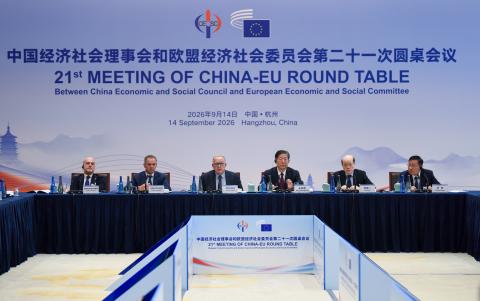
The European Economic and Social Committee (EESC) called for a balanced, forward-looking and people-centred approach to EU-China relations, stressing the need to address growing trade imbalances, strengthen efforts to combat poverty, promote trustworthy and human-centred artificial intelligence, and maintain an open dialogue on human rights.
These messages emerged from the 21st EU-China Round Table, held in Hangzhou, China, on 14 September, which brought together 12 EESC members led by President Séamus Boland and a delegation of the China Economic and Social Council (CESC) led by President Wang Dongfeng to promote civil society dialogue and tackle key global socio-economic challenges. The EU's new Ambassador to China Caspar Veldkamp also participated in the opening session.
The Round Table focused on three themes of common interest: poverty reduction and social inclusion, EU-China trade and investment relations, and people-centred artificial intelligence. In a period marked by economic uncertainty, geopolitical tensions and rapid technological change, participants underlined the importance of sustained dialogue between organised civil society in Europe and China.
EESC President Séamus Boland said: "Europe and China may have different systems and perspectives, but we share a responsibility to ensure that economic development improves people’s lives. Open dialogue helps us address our differences, tackle shared challenges and promote fairer, more sustainable and more inclusive societies. Civil society has an important role to play in building trust, advancing people-centred innovation and ensuring that prosperity reaches all citizens,” he said.
On trade and investment, the EESC stressed that the economic relationship between the EU and China remains one of the world’s most important but pointed to growing imbalances which risks endangering European industry and workers and undermining the European social model. The Committee noted that the EU’s trade deficit in goods with China has increased significantly in recent years and called for greater reciprocity, a level playing field and improved market access for European businesses. The EESC also emphasised the need to address concerns linked to industrial overcapacity and market distortions while preserving mutually beneficial economic cooperation.
The discussions on poverty and social inclusion highlighted the importance of ensuring that economic progress translates into improved living standards and opportunities for all citizens. The EESC welcomed exchanges on the respective experiences of the EU and China in addressing poverty, while stressing that poverty remains a multidimensional challenge requiring strong social protection systems, access to quality public services, adequate housing and inclusive labour markets.
Participants also exchanged views on the development of people-centred artificial intelligence. The EESC advocated an approach to AI that places human dignity, social inclusion, workers’ rights and ethical principles at its core. The Committee highlighted the potential of AI to support ageing societies, improve accessibility for persons with disabilities and enhance quality of life, provided that technological advances remain aligned with human values and societal needs.
The EESC further reiterated that human and workers' rights, including freedom of association in the workplaces and freedom of activities for trade union activists, remain an essential component of EU-China relations. On Ukraine, the Committee stressed the EU's strong support in the face of Russia's war of aggression and called for a comprehensive, just and lasting peace.
The 21st EU-China Round Table forms part of the long-standing cooperation between the EESC and the CESC. It reflects the shared commitment of organised civil society to foster dialogue, understanding and practical cooperation on issues of global importance, including through multilateralism.
The EESC mission opened with a preparatory bilateral between EESC President Séamus Boland and his Round Table co-chair Chinese CESC President Wang Dongfeng. The EESC delegation will also participate in the China Economic and Social Forum 2026, the CESC's annual event convening Chinese politicians, business, think tanks and national economic and social councils, in Hangzhou on 15 September 2026.
Work organisation
Recommended for you
Pro odolnost EU má zásadní význam aktivní úloha organizované občanské společnosti
News
Na plenárním zasedání EHSV se diskutovalo o tom, jak roste význam organizované občanské společnosti a měst, neboť ovlivňují schopnost Evropy čelit asymetrickým otřesům a neočekávaným…
Mladí lidé coby hybatelé změn a evropské integrace zemí západního Balkánu
News
V rámci konference občanské společnosti na vysoké úrovni na téma Politika v oblasti mládeže v zemích západního Balkánu, kterou uspořádal Evropský hospodářský a sociální výbor (EHSV),…
České předsednictví chce dát Evropě nové pojetí, novou podobu a nový impuls
News
Jedním z bodů červencového plenárního zasedání Evropského hospodářského a sociálního výboru (EHSV) byla diskuse s českým ministrem zahraničních věcí Janem Lipavským o…
Vaše Evropa, váš názor (YEYS!) 2023: Mladí lidé požadují transparentnější, digitálnější a zjednodušenou EU
News
Evropský hospodářský a sociální výbor (EHSV) uspořádal ve dnech 23. a 24. března 14. ročník akce Vaše Evropa, váš názor (YEYS!). V jejím rámci se v Bruselu sešlo 105 studentů z 35 škol ze všech 27…
Spravedlivý přechod na nízkouhlíkovou společnost není možný bez účasti občanské společnosti
News
Dolní Vítkovice v Ostravě jsou bývalou průmyslovou oblastí, kde se dříve těžilo uhlí a vyráběla ocel. 11. října 2022 se zde na konferenci sešli zástupci akademické obce, místních…