
European Economic
and Social Committee
Building the workforce of tomorrow: harnessing diversity and innovation for a competitive Europe
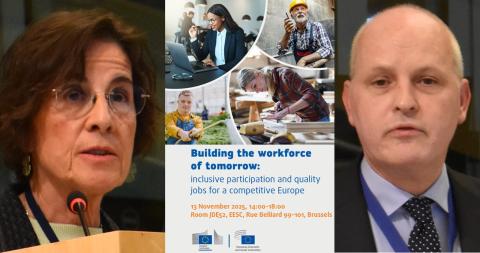
The EESC hosted a high-level conference on 13 November 2025, entitled “Building the workforce of tomorrow: inclusive participation and quality jobs for a competitive Europe.” The event brought together EU policymakers, social partners, researchers, and civil society to discuss the urgent challenges and opportunities facing Europe’s labour market, with a focus on two flagship reports.
Cinzia Del Rio, president of the Section for Employment, Social Affairs and Citizenship and Jeroen Jutte, Director for Employment and Social Governance Analysis from the European Commission highlighted the challenges facing the EU labour market.
As Jeroen Jutte explained: "Labour and skills shortages threaten to slow Europe’s transition efforts, towards a greener economy and a strengthened independence. The analysis provided by the Commission underpins sound policies to bring more people into the labour market and increase productivity. Good analysis and facts are critically important for good policy making."
For her part, President Del Rio stressed that: "We need to secure resources and social spending to support employment, social targets and address new challenges. Investing in skills, promoting quality jobs, as well as eradicating poverty and marginalisation remain the key objectives of our joint work with the European Commission."
The EU faces persistent and emerging hurdles: demographic decline, skills shortages, labour market mismatches, and the need to ensure social cohesion and competitiveness in a rapidly changing world. Over 50 million working-age Europeans remain outside the labour market, with women, older people, migrants, and persons with disabilities particularly underrepresented. The conference underscored that unlocking the potential of these groups is both a social and economic imperative.
In her closing remarks, Alina-Stefania Ujupan, Head of Cabinet to the Executive Vice-President of the European Commission, Roxana Mînzatu, stressed the urgent need to address Europe’s labour market challenges, especially low productivity and the exclusion of women, migrants, and older people from work. She highlighted new EU initiatives like the Union of Skills as well as upcoming initiatives like the Fair Labour Mobility Package and the Quality Jobs Roadmap, all aimed at supporting transitions and creating quality jobs.
Unlocking the potential of people (Employment and Social Developments in Europe report)
The first panel, focusing on the Employment and Social Developments in Europe 2025 report (ESDE 2025) report, explored how inclusive participation can help address labour shortages and demographic change. Speakers emphasized that while the EU is on track to reach its 2030 employment target, progress is uneven. The gender employment gap remains at 10 percentage points, and persons with disabilities face a 24-point employment gap compared to those without disabilities. Migrants and people with low education also continue to face significant barriers. Elva Bova (Head of Unit for Analysis and Statistics at DG EMPL) presented the core findings of the ESDE report, highlighting the demographic challenges facing the EU workforce, including the projected loss of one million workers per year by 2050 and the resulting persistent labour shortages.
To address these challenges, the panel stressed the need for a comprehensive approach. Expanding affordable care services is essential to enable more women to participate in the workforce, while pension reforms and flexible work arrangements can help older people remain in employment longer. For migrants, integrated approaches that combine language training, skills recognition, and simplified work permits are crucial, and persons with disabilities benefit most from supported employment, quotas, anti-discrimination measures, and workplace adaptation. Addressing underemployment, particularly among women and in sectors like hospitality and cleaning, could unlock the equivalent of 2.3 million full-time jobs. The panel also highlighted the importance of education and lifelong learning, with higher educational attainment linked to increased participation and resilience in the face of demographic change. Active labour market policies, public employment services, and social dialogue were identified as crucial levers for supporting vulnerable groups and ensuring that no one is left behind.
A labour market in transition (Labour Market and Wage Developments in Europe report)
The second panel turned to the Labour Market and Wage Developments in Europe 2025 report (LMWD 2025) report, examining how to promote quality jobs and competitiveness in a context of structural change, technological transformation, and global uncertainty. Nathalie Darnaut (Head of Unit, Labour Market and Wages, DG EMPL) presented the main findings: while employment growth has been robust, it is slowing, and productivity growth remains weak compared to other advanced economies.
The discussion revealed that labour shortages remain high in many sectors, despite a slight easing in 2024. Job quality and wage adequacy are central to attracting and retaining workers, especially in essential sectors like health, care, and transport. Real wages have rebounded after the pandemic and energy crisis, with low-wage earners seeing the greatest improvements, but middle-income workers in some countries continue to struggle with the cost of living. Structural shifts are evident, with high-skilled, high-paying jobs in sectors like pharmaceuticals and telecommunications growing, while low-skilled jobs in manufacturing and retail have declined due to automation and upskilling. However, nearly one-third of jobs remain in low- and medium-wage, low-productivity sectors, and overqualification and skills mismatches are widespread. The panel discussed the importance of boosting productivity through innovation, digitalisation, and investment in human capital. The forthcoming Quality Jobs Roadmap and the Union of Skills initiative were highlighted as key EU actions to support upskilling, fair wages, and smooth job transitions. Well-designed job retention schemes, as demonstrated during the COVID-19 crisis, can also play a vital role in safeguarding employment and supporting workers during restructuring.
Policy priorities and the way forward
Throughout the conference, speakers and participants stressed that building the workforce of tomorrow requires a comprehensive, inclusive, and forward-looking policy mix. Promoting inclusive participation means removing barriers for women, older people, migrants, and persons with disabilities, while investing in skills and lifelong learning is essential to adapt to technological and demographic change. Ensuring quality jobs and fair wages through minimum wage protection, collective bargaining, and improved working conditions is vital, as is supporting job transitions and resilience with active labour market policies, job retention schemes, and targeted support for vulnerable groups. Finally, strengthening social dialogue and civil society engagement is necessary to ensure that all voices are heard in shaping the future of work.
The conference concluded that Europe’s competitiveness and social cohesion depend on harnessing the full potential of its people. By fostering inclusive participation and quality jobs, the EU can build a resilient, innovative, and fair workforce ready to meet the challenges of tomorrow.
Work organisation
Recommended for you
Pro odolnost EU má zásadní význam aktivní úloha organizované občanské společnosti
News
Na plenárním zasedání EHSV se diskutovalo o tom, jak roste význam organizované občanské společnosti a měst, neboť ovlivňují schopnost Evropy čelit asymetrickým otřesům a neočekávaným…
Mladí lidé coby hybatelé změn a evropské integrace zemí západního Balkánu
News
V rámci konference občanské společnosti na vysoké úrovni na téma Politika v oblasti mládeže v zemích západního Balkánu, kterou uspořádal Evropský hospodářský a sociální výbor (EHSV),…
České předsednictví chce dát Evropě nové pojetí, novou podobu a nový impuls
News
Jedním z bodů červencového plenárního zasedání Evropského hospodářského a sociálního výboru (EHSV) byla diskuse s českým ministrem zahraničních věcí Janem Lipavským o…
Vaše Evropa, váš názor (YEYS!) 2023: Mladí lidé požadují transparentnější, digitálnější a zjednodušenou EU
News
Evropský hospodářský a sociální výbor (EHSV) uspořádal ve dnech 23. a 24. března 14. ročník akce Vaše Evropa, váš názor (YEYS!). V jejím rámci se v Bruselu sešlo 105 studentů z 35 škol ze všech 27…
Spravedlivý přechod na nízkouhlíkovou společnost není možný bez účasti občanské společnosti
News
Dolní Vítkovice v Ostravě jsou bývalou průmyslovou oblastí, kde se dříve těžilo uhlí a vyráběla ocel. 11. října 2022 se zde na konferenci sešli zástupci akademické obce, místních…