
European Economic
and Social Committee
The bold EU’s 2040 climate target is indispensable for climate neutrality and economic competitiveness, says the EESC
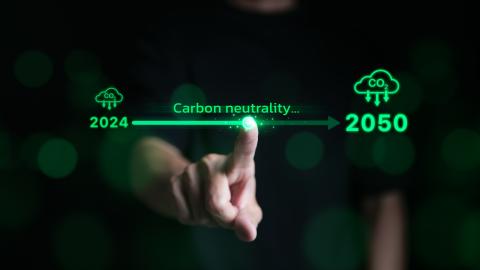
In its effort to lead global climate action, the European Union should set an ambitious target for 2040, aiming to reduce net greenhouse gas emissions by 90%, in line with its broader goal of achieving climate neutrality by 2050. This target, endorsed by the European Economic and Social Committee (EESC) at its September plenary session, aligns with the scientific consensus on the need to limit global warming to 1.5°C.
The Committee reiterated the need for significant investment in innovation, a skilled workforce, and the full implementation of the Fit for 55 legislation, in order to achieve the 2030 interim goal of a 55% emissions reduction. Already at its May plenary, the EESC adopted an opinion outlining the necessary steps to be taken to meet these targets. The Committee also warns against over-reliance on carbon removals, which could be undermined by risks such as forest fires or pest outbreaks, and emphasises the priority of reducing emissions directly.
The EESC President, Oliver Röpke, said: ‘The EESC was the first EU body to endorse this ambitious target when we adopted our opinion on the EU climate target for 2040 in July of this year. Yet, achieving this goal requires more than ambition. We need a comprehensive and truly inclusive approach, involving all stakeholders – from industry to civil society – to develop and implement the policies necessary for a successful transition to a low-carbon economy.’
Kurt Vandenberghe, Director-General of the European Commission’s Directorate-General for Climate Action (DG CLIMA), highlighted the importance of ensuring a fair and competitive transition for European industries. ''Decarbonisation does not mean degrowth or deindustrialisation'', he said. He emphasised that if Europe’s ambitious climate targets are matched by a coherent plan, decarbonisation will present opportunities, citing insights from the recent Draghi report.
Professor Ottmar Edenhofer, chair of the European Scientific Advisory Board on Climate Change, presented the findings from the report evaluating, among other, carbon policies toward EU climate neutrality, stressing that policy-makers must make critical choices.
Teppo Säkkinen, rapporteur of the EESC opinion, stressed that coordinated action across all sectors is crucial in achieving the 2040 target. ‘The EESC advocates for an emissions reduction target for the agri-food sector, developed in consultation with farmers and stakeholders, while ensuring food security across Europe’s diverse natural landscapes’, he said. He also called for genuine emissions reductions, achieved by phasing out fossil fuels and creating a carbon-free electricity system by 2040 in order to decarbonise key sectors like industry, transport, and buildings.
The EESC emphasises the need for broad stakeholder dialogue, including the social partners, civil society, and citizens, to build public support for the climate plan. The Committee also recommends carrying out a competitiveness check with respect to other major global economies to ensure that Europe’s climate policies are economically viable and its industries remain competitive on the global stage.
As the EU prepares its legislative proposal for the 2040 climate target, the EESC stands ready to support a policy framework that combines environmental protection with economic resilience and social fairness, securing a sustainable future for all.
The EESC delegation will convey this message at the Summit of the Future in New York, the biodiversity COP in Kali, and the climate COP in Baku.
For more information, please contact:
EESC Press Unit
E-mail: aikaterini.serifi@eesc.europa.eu
Recommended for you
Pro odolnost EU má zásadní význam aktivní úloha organizované občanské společnosti
News
Na plenárním zasedání EHSV se diskutovalo o tom, jak roste význam organizované občanské společnosti a měst, neboť ovlivňují schopnost Evropy čelit asymetrickým otřesům a neočekávaným…
Mladí lidé coby hybatelé změn a evropské integrace zemí západního Balkánu
News
V rámci konference občanské společnosti na vysoké úrovni na téma Politika v oblasti mládeže v zemích západního Balkánu, kterou uspořádal Evropský hospodářský a sociální výbor (EHSV),…
České předsednictví chce dát Evropě nové pojetí, novou podobu a nový impuls
News
Jedním z bodů červencového plenárního zasedání Evropského hospodářského a sociálního výboru (EHSV) byla diskuse s českým ministrem zahraničních věcí Janem Lipavským o…
Vaše Evropa, váš názor (YEYS!) 2023: Mladí lidé požadují transparentnější, digitálnější a zjednodušenou EU
News
Evropský hospodářský a sociální výbor (EHSV) uspořádal ve dnech 23. a 24. března 14. ročník akce Vaše Evropa, váš názor (YEYS!). V jejím rámci se v Bruselu sešlo 105 studentů z 35 škol ze všech 27…
Spravedlivý přechod na nízkouhlíkovou společnost není možný bez účasti občanské společnosti
News
Dolní Vítkovice v Ostravě jsou bývalou průmyslovou oblastí, kde se dříve těžilo uhlí a vyráběla ocel. 11. října 2022 se zde na konferenci sešli zástupci akademické obce, místních…