GDP is the best-known measure of macro-economic activity. While it is used both by policy-makers around the world and in public debates, it was not designed to be a comprehensive measure of prosperity and well-being. Thus, other indicators are needed to assess and address the global challenges of the 21st century such as climate change, poverty, resource depletion and to promote health and a higher quality of life. Beyond GDP indicators should become instruments to not only monitor and measure, but also to inform policy development, improve communication and encourage target setting. Against this background, the Section for Economic and Monetary Union and Economic and Social Cohesion (ECO) of the European Economic and Social Committee (EESC) is currently working on an own-initiative opinion on 'Beyond GDP measures for a successful recovery and a sustainable and resilient EU economy'.
The EESC is organising an online public hearing to gather stakeholders' and civil society's views on the new EU Forest Strategy for 2030, which will feed into the preparation of the EESC opinion on this topic.
Both a sustainable economic and social recovery from the COVID-19 crisis and the need to address effectively the climate change will require a massive expansion of investments. To achieve this, reshaping the EU fiscal rules is indispensable. Against this background, the Section for Economic and Monetary Union and Economic and Social Cohesion (ECO) of the European Economic and Social Committee (EESC) is currently working on an own-initiative opinion on Reshaping the EU Fiscal Framework for a Sustainable Recovery and a Just Transition.
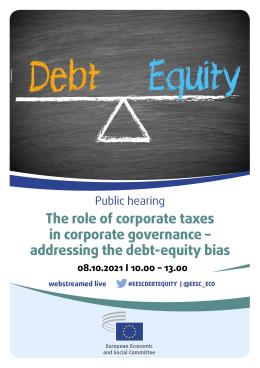
In order to reshape the European economy and in line with the objectives stated by the European Commission for a more sustainable, greener and digitalised economy, investments must support environmental goals and remove obstacles to corporate dividend policymaking and payments. Among many other factors, the debt-equity bias in the corporate tax systems affects both the leverage of firms and corporate governance. The EESC welcomes the recent public consultation on a new initiative to mitigate the debt-equity bias in corporate taxation launched by the European Commission and shares the Commission's view that companies should contribute to the achievement of a greener, sustainable and digitalised economy.
The EESC aspires to contribute to the ongoing public debate andwill hold an online public hearing ‘’The role of corporate taxes in corporate governance - addressing the debt-equity bias" on 8 October 2021. The event is accessible via webstream. No registration is needed and participation is free of charge.
In the framework of the additional opinion on "The Annual Sustainable Growth Strategy 2021", the European Semester Group of the ECO section will organise a public hearing to discuss semester related developments since the original opinion was adopted in February 2021. The event will focus on the implementation of the National Recovery and Resilience Plans (NRRPs) and collect views of various organisations, national Economic and Social Councils, EU bodies and think tanks on the topic. With this opinion the EESC aspires to contribute to the 2022 European Semester cycle and this hearing is part of a stock taking and forward looking exercise from a civil society perspective.
European Economic and Social Committee (EESC), Jacques Delors building, Rue Belliard 99, 1040, Brussels, Belgium
Brussels
Belgium
On 6 September 2021, the EESC's Labour Market Observatory will hold a remote public hearing on collective bargaining practices in Member States with a low labour union participation rate.
This online public hearing will discuss how to transform the targets proposed in the Action Plan for the development of EU organic production into on-the-ground strategies related to organic production and consumption.
In the framework of the elaboration of its own-initiative opinion on "Advertising for modern, responsible consumption", the EESC organized a hearing which aimed at gathering the point of view of different actors. The conclusions of the hearing will then be integrated into the opinion.
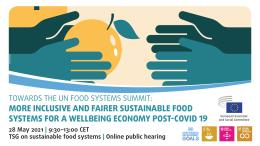
The online public hearing organised by the EESC in the context of the EESC Thematic Study Group (TSG) on Sustainable Food Systems aims to explore the vulnerabilities and inequalities of European food systems and to identify the enablers to achieve more equitable and fair supply chains.
The pandemic transformation is causing a significant shift in the global balance of power. The EU must act as soon as possible to boost Europe's economic resilience in the COVID-19 context and build its open strategic autonomy. This includes, among other elements, strengthening the international role of the euro, increasing the resilience of European financial market infrastructures, and improving the enforcement of EU sanctions.
Against this background, the European Economic and Social Committee (EESC) welcomes the recent communication of the European Commission on The European economic and financial system: fostering openness, strength and resilience [COM(2021) 32 final] and will hold a public hearing to discuss the specific policy recommendations and key actions it contains. The hearing will feed directly into the upcoming EESC opinion on the Commission's communication and the related inter-institutional debate.