
European Economic
and Social Committee
AI can help advance treatment for rare diseases
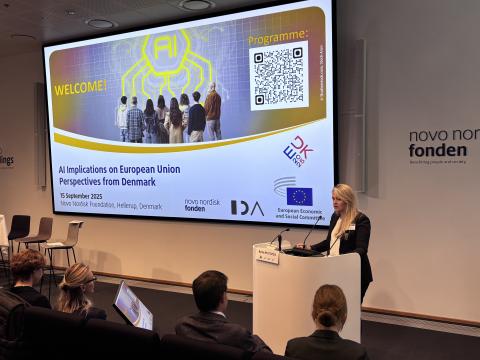
A conference held in Denmark by the European Economic and Social Committee (EESC) highlighted the vital role that artificial intelligence could play in offering new forward-looking solutions to treat rare diseases.
Artificial intelligence (AI) can offer new solutions to help make progress in the treatment of rare diseases: this was the main idea behind the conference organised by the EESC’s Section for Transport, Energy, Infrastructure and the Information Society (TEN), the Novo Nordisk Foundation and the Danish Society of Engineers (IDA) in Hellerup, Denmark, on 15 September 2025.
The event, organised under the auspices of the Danish Presidency of the Council of the European Union, focused on the role of AI in enhancing rare disease research and treatment; it featured a presentation of the initial findings of the EESC exploratory opinion AI, Big Data and Rare Diseases requested by the Danish Presidency.
The widespread availability of AI infrastructure and the adoption of AI is likely to have a significant impact on society and the economy. AI can improve the efficiency and quality of public services such as healthcare, education and transport, and it can also make these services more accessible to marginalised communities by offering tailored solutions and reducing access barriers. By automating tasks and optimising processes, AI can boost productivity across a variety of sectors, fostering economic growth and boosting competitiveness.
AI can improve quality of life for patients with rare diseases
People affected by rare diseases face a stark reality. Today, more than 30 million Europeans are living with a rare disease. Nearly 70% of these conditions begin in childhood and tragically 30% of children affected will not live past the age of five. Families wait an average of four to five years for a diagnosis – a period characterised by uncertainty, sometimes misdiagnoses, and very often lost opportunities. In any event, overall, 95% of rare diseases still have no approved treatment.
Digitalisation, in particular AI, can play a key role in empowering individuals and families affected by rare diseases. AI can significantly enhance their quality of life by shortening the diagnostic journey and improving care coordination.
For example, AI-assisted tools can detect patterns in genetic code and medical images which are invisible to the human eye. They could therefore cut diagnostic delays and point to treatments that would otherwise remain undiscovered.
According to recent studies, these tools can reduce diagnostic errors by up to 40% and in some cases suggest effective therapies faster than traditional methods. These technologies could allow children to get a diagnosis in months, rather than years, and treatment would be personalised, not generic.
However, to achieve these objectives, the European Union must act wisely: it is essential to keep patient rights, privacy, and consent in the spotlight, and at the same time to put in place more robust data governance, anonymised and secure data, and independent monitoring.
The EESC’s exploratory opinion is expected to be adopted at its plenary session this week. On the use of AI, the EESC has recently adopted the opinions Regulatory simplification - the use of digital tools in better law-making, drawn up by EESC member Alena Mastantuono, and General-purpose AI: way forward after the AI Act, drafted by EESC member Sandra Parthie.
Quotes from speakers
‘As the EESC, we have a unique and vital role in ensuring that the voice of organised civil society is heard when shaping the future of technologies such as AI, big data, and quantum computing. These fields are not just transforming our economies and societies; they are redefining the very way we live, work and interact. It is therefore essential that ethical, inclusive and human-centred perspectives guide their development. Through dialogue, expertise and collaboration, the EESC stands as a bridge between citizens, stakeholders and policymakers, helping to ensure that innovation serves the common good.’
Baiba Miltoviča, President of the Section for Transport, Energy, Infrastructure and the Information Society (TEN), European Economic and Social Committee (EESC)
‘AI has transformational potential and is an area where Europe, and Denmark in particular, is currently gaining momentum. In the global AI race, Europe could pave the way for responsible use of AI while safeguarding data privacy and democratic values. At the Novo Nordisk Foundation, we see AI and quantum technology as enablers to benefit from high-quality data in a responsible manner. However, for Europe to meet this potential, significant and coordinated investment in proper infrastructure, talent and know-how is critical.’
Lene Oddershede, Chief Scientific Officer, Novo Nordisk Foundation
‘A better future is possible for people affected by rare diseases: a future where there is fairness and hope, ensuring that innovation works for people, not the other way around. AI should never replace human judgement, but it can empower us to bring dignity, speed, and care to those who need it most. We can build a Europe where rare diseases no longer mean a lifetime of waiting and uncertainty, but a future of solutions, solidarity, and better health for all.’
Juliane Marie Neiiendam, Regional Chair of the Danish Society of Engineers (IDA) and EESC member, rapporteur for the EESC opinion AI, Big Data and Rare Diseases
‘Recently another very interesting piece of legislation has conquered the agenda around health data and digitalisation, shifting priorities all across Europe in one direction. The European Health Data Space was put into force on 26 March 2025 and is expected to play a significant role in health data and digitalisation in and across Europe over the coming years.’
Kenneth Bøgelund Ahrensberg, Senior Global Policy Advisor, Danish Health Data Authority