
European Economic
and Social Committee
EU must shift from ‘firefighting to foresight’, EESC warns in push to reinforce civil protection
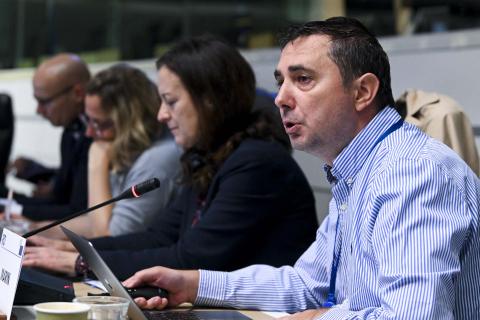
In an opinion that was adopted at its December plenary, the European Economic and Social Committee (EESC) urges the European Commission to radically strengthen the Union Civil Protection Mechanism (UCPM), calling for a strategic pivot away from last-minute emergency response and toward comprehensive disaster prevention. The warning comes as Europe faces increasingly volatile climate extremes, cyber-physical threats, and geopolitical instability.
Rapporteur Florian Marin said the EU is still behaving as though each crisis is an unexpected anomaly. “We treat disasters like sudden shocks,” Marin said. “But the science is clear: most of them are predictable, intensifying and interconnected. Prevention is no longer optional, it is Europe’s most cost-effective, humane and strategic defence.”
A system stretched by crises
The UCPM has undergone several reforms, including a major update in 2021 and the creation of the rescEU reserve after devastating wildfires in Portugal and Greece. These reforms expanded shared firefighting fleets, medical evacuation capacity and emergency stockpiles.
But the EESC argues that the EU’s legislative architecture, though improved, remains oriented around responding once disaster has already struck, rather than reducing risks in the first place.
Marin highlighted the overlap between civil protection, the EU Climate Adaptation Strategy and the Security Union Strategy, arguing that gaps between these frameworks hinder real-time coordination. “Europe has strong tools,” he said, “but they are fragmented. We need coherence, not a patchwork.”
- Cutting red tape, modernising systems
- reduced administrative burdens and duplication,
- modern, interoperable data and early-warning systems,
- increased trained staff and improved working conditions,
- streamlined procurement rules for rapid access to critical supplies,
- and stable funding for both professional services and volunteers.
The Committee is calling for a suite of upgrades:
It also insists that the next cycle of National and Regional Partnership Plans (2028–2034) integrate disaster-risk reduction as a central pillar, rather than an afterthought.
Disasters without borders
For the EESC, disaster management must reflect Europe’s interconnected geography. Outermost regions, borderlands near conflict zones and rural areas with limited infrastructure all require targeted support.
Recent floods across Central Europe demonstrated how early alerts, interoperable equipment and cross-border rescue teams—coordinated under UCPM—helped reduce damage and save lives. These successes, Marin argues, show the potential of a more unified system.
“A prepared Union is a stronger Union”
“Disasters don’t wait for paperwork,” Marin said. “If Europe wants to protect its people, it must invest in prevention, coordination and solidarity. A prepared Union is a stronger Union—and Europe cannot afford anything less.” (ks)