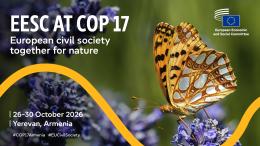
As in previous years, the European Economic and Social Committee (EESC) will actively participate in COP17 to the UN Convention on Biological Diversity (CBD), which will take place from 19 to 30 October 2026 in Yerevan, Armenia.
The insurance protection gap against natural disasters is growing in the EU. In this context, this public hearing creates a space for debate with regulators and organisations on existing evidence, the need for action at EU and local levels, and on specific policy proposals. The takeaways will feed the discussions on our opinion ‘Towards a European system of natural disaster risk management for the EU insurance sector’.
The European Economic and Social Committee (EESC) invites you to attend our public hearing on how using artificial intelligence and digitalisation in tax administration can strengthen legal clarity, cross-border comparability, economic development and tax certainty.
The public hearing will focus on the capacity to reduce fragmentation and compliance burdens, while facilitating compliance and collection across Member States. The hearing will bring together policymakers, stakeholders and experts from across countries and organisations to discuss on digitizing the EU tax system.
Teatro Thalia, Estrada das Laranjeiras 205, Lisboa, Portugal
Lisbon
Portugal
The annual Euro-Mediterranean Summit of Economic and Social Councils and Similar Institutions provides civil society organisations (CSOs) from the UfM Member States with a platform to debate common challenges and opportunities and to exchange best practices.
The permanent group on Inclusion of the Roma is organising a public hearing on 29 October 2026 on the topic of "Inclusive Roma Education, Upskilling and Pathways to Quality Jobs". The hearing will look at:
The role of the EU Union for Skills in Roma integration
Good practices on fighting segregation in education
Good practices on Roma inclusion in the labour market through VET
Roma women's education and integration in the labour market
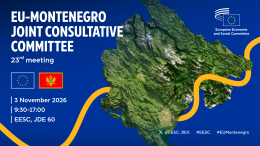
The 23rd meeting of the EU–Montenegro Joint Consultative Committee (JCC) will be held at the EESC in Brussels. Representatives of organised civil society from the EU and Montenegro will discuss recent developments in EU–Montenegro relations and key priorities in Montenegro’s EU accession process.
Launch of the European Employment and Social Outlook (EESO) 2026
Event type
Public hearing
Location
European Economic and Social Committee (EESC), Rue Belliard 99/101
Brussels
Belgium
Jointly organised by the European Commission and the European Economic and Social Committee (EESC), this conference will be an opportunity to discuss key insights from the European Employment and Social Outlook (EESO) 2026 – the flagship report from the European Commission’s Directorate-General for Employment, Social Affairs and Inclusion’s (DG EMPL).
The conference will feature high-level speakers from EU institutions and research institutes. Executive Vice-President of the European Commission, Ms. Roxana Mînzatu, and the President of the EESC's Section for Employment, Social Affairs and Citizenship, Ms. Cinzia Del Rio, will open the event.