European Economic
and Social Committee
European Economic
and Social Committee
The European Economic and Social Committee (EESC) is the voice of organised civil society in Europe.
Find out more about its role and structure at http://www.eesc.europa.eu/en/about
The EESC issues between 160 and 190 opinions, evaluation and information reports a year.
It also organises several annual initiatives and events with a focus on civil society and citizens’ participation such as the Civil Society Prize, the Civil Society Days, the Your Europe, Your Say youth plenary and the ECI Day.
Find the latest EESC opinions and publications at http://www.eesc.europa.eu/en/our-work/opinions-information-reports/opinions and http://www.eesc.europa.eu/en/our-work/publications-other-work/publications respectively.
The EESC is active in a wide range of areas, from social affairs to economy, energy and sustainability.
Learn more about our policy areas and policy highlights at http://www.eesc.europa.eu/en/policies
The EESC holds nine plenary sessions per year. It also organises many conferences, public hearings and high-level debates related to its work.
Find out more about our upcoming events at http://www.eesc.europa.eu/en/agenda/our-events/upcoming-events
Here you can find news and information about the EESC'swork, including its social media accounts, the EESC Info newsletter, photo galleries and videos.
Read the latest EESC news http://www.eesc.europa.eu/en/news-media/news and press releases http://www.eesc.europa.eu/en/news-media/press-releases
The EESC brings together representatives from all areas of organised civil society, who give their independent advice on EU policies and legislation. The EESC's326 Members are organised into three groups: Employers, Workers and Various Interests.
Find out more about our Members and groups at http://www.eesc.europa.eu/en/members-groups
The EESC has six sections, specialising in concrete topics of relevance to the citizens of the European Union, ranging from social to economic affairs, energy, environment, external relations or the internal market.
Find out more at http://www.eesc.europa.eu/en/sections-other-bodies
Europe’s response to terrorism and violent extremism must combine effective security measures with prevention, democratic resilience and the systematic involvement of civil society, says the European Economic and Social Committee (EESC).
In its opinion on the ProtectEU Agenda for preventing and countering terrorism, drafted by rapporteur Christian Moos, the EESC warns that terrorism, organised crime and hostile foreign interference are increasingly overlapping and calls for a comprehensive response that does not compromise democracy, fundamental rights or the rule of law.
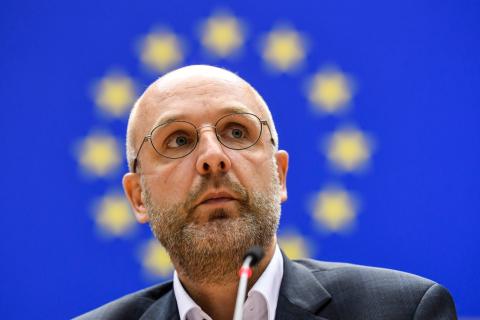
'Terrorism, sabotage and organised crime increasingly overlap. ProtectEU requires stronger cooperation among authorities, smarter information-sharing and greater prevention, developed together with civil society to strengthen resilience, security and democracy,’ Mr Moos said.
The Committee argues that strong public institutions, social cohesion, education and active civic participation can help reduce vulnerability to extremist narratives. It therefore wants counter-terrorism policy to pay greater attention to prevention and the root causes of radicalisation, alongside operational security measures.
The workplace also has an important role to play. The EESC calls for the social partners and organised civil society to be more systematically involved in prevention programmes, early-warning mechanisms and preparedness strategies.
With almost one third of terrorist suspects in the EU in 2024 aged under 20, the Committee also supports stronger measures to protect minors online, including education, media literacy and safeguards against harmful content.
The EESC backs stronger protection of public spaces and critical infrastructure, better information-sharing and closer institutional cooperation, but stresses that security measures must remain proportionate and compatible with fundamental rights and open democratic life. (lm)