European Economic
and Social Committee
European Economic
and Social Committee
The European Economic and Social Committee (EESC) is the voice of organised civil society in Europe.
Find out more about its role and structure at http://www.eesc.europa.eu/en/about
The EESC issues between 160 and 190 opinions, evaluation and information reports a year.
It also organises several annual initiatives and events with a focus on civil society and citizens’ participation such as the Civil Society Prize, the Civil Society Days, the Your Europe, Your Say youth plenary and the ECI Day.
Find the latest EESC opinions and publications at http://www.eesc.europa.eu/en/our-work/opinions-information-reports/opinions and http://www.eesc.europa.eu/en/our-work/publications-other-work/publications respectively.
The EESC is active in a wide range of areas, from social affairs to economy, energy and sustainability.
Learn more about our policy areas and policy highlights at http://www.eesc.europa.eu/en/policies
The EESC holds nine plenary sessions per year. It also organises many conferences, public hearings and high-level debates related to its work.
Find out more about our upcoming events at http://www.eesc.europa.eu/en/agenda/our-events/upcoming-events
Here you can find news and information about the EESC'swork, including its social media accounts, the EESC Info newsletter, photo galleries and videos.
Read the latest EESC news http://www.eesc.europa.eu/en/news-media/news and press releases http://www.eesc.europa.eu/en/news-media/press-releases
The EESC brings together representatives from all areas of organised civil society, who give their independent advice on EU policies and legislation. The EESC's326 Members are organised into three groups: Employers, Workers and Various Interests.
Find out more about our Members and groups at http://www.eesc.europa.eu/en/members-groups
The EESC has six sections, specialising in concrete topics of relevance to the citizens of the European Union, ranging from social to economic affairs, energy, environment, external relations or the internal market.
Find out more at http://www.eesc.europa.eu/en/sections-other-bodies
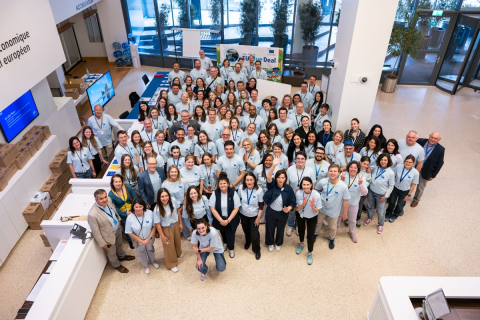
Thousands of people visited the EESC headquarters in Brussels on Saturday 9 May 2026, when the EU’s oldest consultative body opened its doors for the traditional Open Day.
9 May, Europe Day, marks the 76th anniversary of the Schuman Declaration, the historic speech by French foreign minister Robert Schuman in 1950 which paved the way for European integration. Europe Day is a chance to acknowledge the achievements of the European project and celebrate the community of values that the EU represents and that we, as Europeans, protect and nourish every day.
‘Europe Day is a really important day for taking stock and celebrating the achievements of the European project, including peace, democracy and inclusion,’ Séamus Boland, the EESC President, said. ‘It was a genuine pleasure to host visitors to our open day today and celebrate this spirit of participation.’
‘I am very happy that the EESC could host an open-door and festive celebration for Europe Day,’ added Marija Hanževački, the EESC Vice-President for Communication. ‘Europe Day is a celebration of joy and unity for people of all ages to share European values and build a Europe for all. The Open Day offers a unique opportunity to experience the spirit of engagement first hand, discover the workings of the Committee and learn how complex debates are turned into opinions.’
During the EESC Open Day, visitors were able to step inside the Committee building and find out how it gives a voice to organised civil society across the EU and thus contributes to European democracy. They had the opportunity to meet the people behind the work, explore how EESC opinions are drawn up and experience personally how inclusive dialogue helps to shape Europe’s future and build a stronger Union. (mp)