An initiative of the Civil Society Organisations’ Group in cooperation with Friends of the Earth Europe
-
Location
EESC headquarters, JDE building, Rue Belliard/Belliardstraat 99-101
Brussels
Belgium
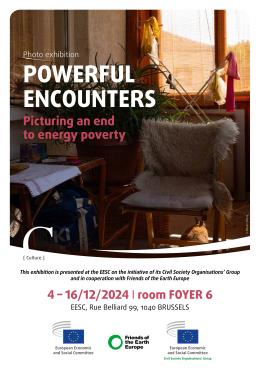
The European Economic and Social Committee (EESC) presented the photo exhibition ‘Powerful Encounters: Picturing an end to energy poverty’ on the initiative of its Civil Society Organisations’ Group and in cooperation with Friends of the Earth Europe. The work of photographer Miriam Strong was exhibited from 4 to 16 December 2024 at the EESC’s premises in Brussels.
This resolution presents recommendations of the European Economic and Social Committee to the legislature 2024-2029. They are based on discussions with social partners and civil society organizations from all walks of life, including young people during the first EESC Civil Society Week, and contain a comprehensive set of actionable steps to strengthen and safeguard democratic principles.
Protecting the most vulnerable in European societies
In this issue:
Our members reflect on ways for protecting the most vulnerable in European societies;
Guest articles by Carlos SUSÍAS RODADO (European Anti Poverty Network), Sirpa RAUTIO (European Union Agency for Fundamental Rights), Rocío URÍAS MARTÍNEZ (European Federation of National Organisations Working with the Homeless) and Rainer HUB (National Network for Civil Society in Germany);
Report on our recent conference on intergenerational solidarity in the EU;
Interview with rapporteur Pietro Vittorio BARBIERI on the new EESC opinion on 'Caregivers'.
Civil Society Organisations' Bulletin - October 2024
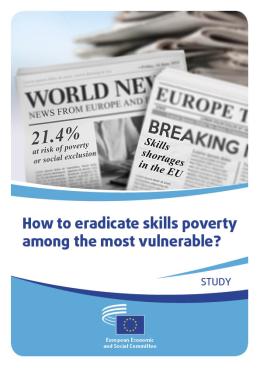
How to eradicate skills poverty among the most vulnerable? On 10 July, the Civil Society Organisations’ Group of the European Economic and Social Committee held a thematic debate exploring this question. The debate saw the launch of a new exploratory study on this same issue.
This study extensively explores what determinants of unique circumstances of vulnerability most affect access to skills, identifying characteristics that can lead to skills poverty
80% of Roma remain at risk of poverty, far more than the rate of 16.8% for the general population. Whilst surveys show a decrease in the rate of Roma living in severe material deprivation, this still contrasts sharply to the rate amongst non-Roma. Reducing this poverty gap is one of the main objectives of the new EU Roma strategic framework, which foresees to cut this by half by 2030. The hearing will look at recent surveys on poverty amongst the Roma. It will discuss in more detail how EU policies on combatting poverty can be taken forward and contribute to improving the situation of the Roma community. It will also discuss measures and good practices on how the poverty gap can be narrowed.
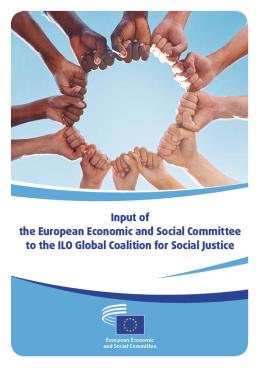
This document seeks to provide input to the Global Coalition for Social Justice. It highlights key messages from EESC opinions on the six priority areas identified by the International Labour Organization (ILO) for immediate action.