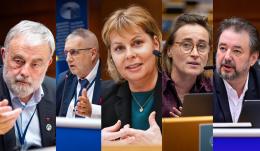
From breaking intergenerational disadvantage and tackling child poverty to ending homelessness and protecting civic space, the European Economic and Social Committee (EESC) is calling for a comprehensive, rights-based approach to poverty. Key opinions adopted during its October plenary underline one central message: lasting solutions must be shaped with the support of civil society and the people most affected.
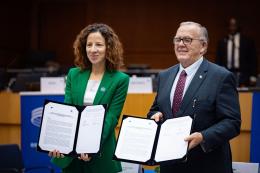
The European Economic and Social Committee (EESC) and the European Commission signed a Memorandum of Understanding to strengthen their cooperation in the fight against poverty and social exclusion. EESC President Séamus Boland, EU policymakers, civil society representatives, social partners and people with lived experience of poverty discussed how Europe can accelerate progress towards eradicating poverty by 2050 at a debate hosted by the EESC.
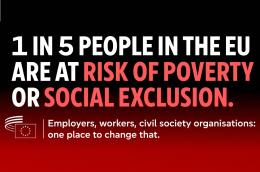
Poverty is not simply a lack of income. It can mean being unable to afford food, heating, healthcare or secure housing, or to participate fully in society. To mark the International Day for the Eradication of Poverty, the European Economic and Social Committee (EESC) highlights its longstanding call for coordinated European action to tackle its many interconnected causes.
Dans cet aperçu, le Comité économique et social européen (CESE) présente ses avissur les propositions de la Commission européenne pour le Cadre financier pluriannuel (CFP) 2028-2034, en rassemblant les points de vue de la société civile organisée sur l’orientation future du budget de l’UE.
rue Belliard 101, Jacques Delors building, room JDE 63, 9:30-11:00
Brussels
Belgium
EESC, room JDE 63, 9:30-11:00
The policy debate brings together stakeholders to assess how National and Regional and Partnership Plans will work in practice. In a workshop setting connected to the European Economic and Social Committee, participants from civil society, social partners and institutions will exchange perspectives on transparency, inclusiveness and impact. The discussion aims to highlight gaps, share best practices and strengthen the role of organised civil society in shaping and monitoring the implementation of NRPPs in the EU.
Cette étude analyse les politiques de l’Union européenne (UE) sous l’angle de la pauvreté intergénérationnelle, en recentrant l’attention sur la persistance à long terme et la transmission des désavantages entre les générations, plutôt que de considérer la pauvreté en tant que condition statique.
Cet avis examine la proposition de la Commission relative à une stratégie européenne de lutte contre la pauvreté et présente les priorités du CESE. Il préconise une approche globale de la pauvreté, fondée sur les droits et tenant compte de toutes les étapes de la vie, qui s’attaque à ses causes structurelles et réponde aux besoins spécifiques des groupes les plus exposés aux risques de pauvreté et d’exclusion. L’avis souligne l’importance d’une protection sociale adéquate, de l’accès à des services essentiels de qualité et de marchés du travail inclusifs, et appelle à renforcer l’action aux niveaux européen et national afin de prévenir la pauvreté et de garantir une inclusion sociale effective.
Download format:
Download — Avis du CESE: Stratégie de lutte contre la pauvreté et pauvreté intergénérationnelle
The European Anti-Poverty Network unveils the 2025 EU Poverty Watch at the EESC, highlighting the role of national and local strategies in the fight against poverty.