
European Economic
and Social Committee
EESC against poverty: placing civil society at the heart of the fight
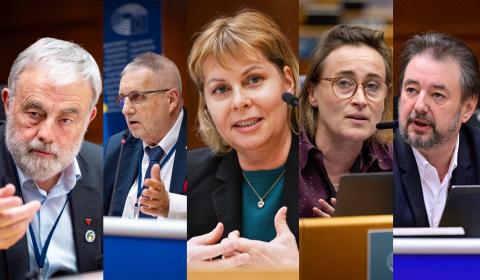
From breaking intergenerational disadvantage and tackling child poverty to ending homelessness and protecting civic space, the European Economic and Social Committee (EESC) is calling for a comprehensive, rights-based approach to poverty. Key opinions adopted during its October plenary underline one central message: lasting solutions must be shaped with the support of civil society and the people most affected.
Poverty is not simply a lack of income. It can mean being unable to afford decent housing, childcare, healthcare or education. It can deprive children of opportunities, follow families from one generation to the next and prevent people from participating fully in society. The opinions adopted address different dimensions of this reality. Together, they argue for coordinated policies that address poverty throughout people’s lives and tackle its structural causes.
A Europe free of poverty
In its opinion on the EU Anti-Poverty Strategy and intergenerational poverty, the EESC describes poverty as a violation of fundamental rights and a systemic injustice. It welcomes the strategy but calls for a dedicated and adequately funded programme, backed by measurable targets and coordinated action at EU and national level.
The Committee stresses that poverty cannot be eradicated through isolated measures. Quality jobs, adequate minimum incomes and pensions, affordable housing, accessible public services, education and childcare must form part of a comprehensive approach. Central to this is breaking the cycle of disadvantage from one generation to the next, including through sustained support from early childhood into adult life.
The opinion also supports structured consultation with people experiencing poverty. Civil society organisations and social partners, it says, must be closely involved in the design, implementation, monitoring and review of the EU strategy.
During the debate surrounding the opinion, rapporteur Jack O'Connor highlighted that: " A little over 10% of those in employment are in poverty. However, it’s actually much worse than that, because most of the one in every four children in poverty in the EU live in households in which at least one adult is working. Moreover, almost one in four working single parents are in poverty. Therefore, there is an urgent need to prioritise decent work."
Co-rapporteur, Krzysztof Balon, further added: "Poverty has many faces and for each situation an individual solution is needed – based on a proper sociopolitical framework but also on protecting human dignity through empowerment. Therefore, people experiencing poverty should be supported not only by material help but also by social work and other social services in achieving skills and commitment to find ways out of the poverty. In providing such support activities of civil society and social economy are crucial. Moreover, people experiencing poverty must have a strong voice about systemic solutions."
Breaking the cycle of child poverty
A second opinion focuses on strengthening the European Child Guarantee. The EESC warns that child poverty is a fundamental rights violation with lasting consequences for children’s development and for social cohesion. It calls for the Guarantee to remain a child-centred, rights-based instrument that ensures access to essential services for children in vulnerable situations.
"Breaking the cycle of child poverty requires early action, adequate funding and strong civil society involvement to guarantee access to essential services for all children, especially those most in need," declared rapporteur Kinga Joó following the opinion's adoption.
The Committee recommends better access to affordable, high-quality childcare and early education, quality employment for parents, more effective child benefits, developmental screening and early support. It also calls for dedicated EU funding and stronger action to remove the legal and administrative barriers that prevent particularly vulnerable children from accessing essential services.
Local authorities and grassroots civil society organisations must be structurally involved in national action plans. Their proximity to vulnerable families allows them to identify needs, reach people who might otherwise remain excluded and help ensure that policies produce results on the ground.
Housing is fundamental to a life of dignity
The opinion on housing exclusion and homelessness by rapporteur Cristian Pîrvulescu calls for homelessness to be treated as an urgent fundamental-rights issue. It supports the "Housing First" principle, under which people experiencing homelessness are offered a dignified home connected to the services and support they need.
The EESC argues that housing cannot be left primarily to the market. Public authorities must regulate and plan, remove barriers to accessing housing and provide social and public housing. Stable investment, predictable funding and cooperation among public authorities, housing providers, the social economy and other stakeholders will be essential.
Civil society organisations, foundations and social economy actors already conduct street outreach and provide essential assistance, psychosocial support and help towards employment. The Committee says they should be recognised and adequately funded as co-producers of the response, rather than treated merely as a supplement to public services. People with direct experience of homelessness must also participate in designing, delivering and evaluating national strategies.
No fight against poverty without civic space
The fourth opinion places civil society at the heart of Europe’s efforts to achieve Sustainable Development Goal 1 on ending poverty. It warns that shrinking civic space and growing pressure on democracy are structural barriers to effective poverty reduction.
Rapporteur Anna Schoemakers stressed that "the EESC sees good opportunities to make the Anti-Poverty Strategy a success and therefore urges the European Commission to treat civil society organisations and their civic space as being of crucial importance – in healthy, functioning democracies they are a prerequisite for poverty reduction — and to address this clearly in the strategy's implementation."
Civil society organisations respond directly to deprivation through food assistance, homeless services, debt advice, disability support, women’s shelters, community education and employment programmes. Their proximity to communities helps them identify emerging needs early, build trust and reach people whom public services may not reach.
Yet many of these organisations face legal uncertainty, unstable funding and attacks on their legitimacy. The EESC therefore calls for appropriate legal frameworks, accessible and predictable financing and structured civil-society participation in the implementation of the EU Anti-Poverty Strategy. Protecting civic space and reducing poverty are mutually reinforcing: democratic participation makes policies more effective, while reducing poverty strengthens social cohesion, trust and democratic resilience.
Giving a voice to those too often unheard
Taken together, the four opinions offer a common vision for Europe’s fight against poverty. Measures must address its many interconnected causes, be backed by adequate public funding and recognise access to essential services as a matter of rights and dignity.
Above all, policies must be shaped with the people they are intended to support. Civil society organisations bring together practical expertise, community knowledge and the voices of people experiencing poverty. By channelling those voices into EU policymaking, the EESC can help ensure that poverty is not discussed only in terms of statistics but addressed through policies rooted in people’s everyday realities.
Work organisation
Recommended for you
Współtworzenie usług publicznych w sektorze opieki zdrowotnej przyczyni się do silniejszej demokracji uczestniczącej w UE
News
Podczas wydarzenia zorganizowanego przez Europejski Komitet Ekonomiczno-Społeczny (EKES) i Uniwersytet w Debreczynie podkreślono kluczowe znaczenie współtworzenia usług świadczonych w interesie…
Zorganizowane społeczeństwo obywatelskie UE nie zostawi Ukrainy
News
Europejski Komitet Ekonomiczno-Społeczny (EKES) zorganizował 19 lipca konferencję wysokiego szczebla nt. pomocy dla Ukrainy i jej odbudowy. Podczas tego wydarzenia zobowiązał się w pełni i na…
Europejski Komitet Ekonomiczno-Społeczny w Gdańsku. - Wolontariusze potrzebują rządowego wsparcia
News
O tendencjach w rozwoju wolontariatu w Unii Europejskiej, o nowych formach wolontariatu, ale też o wsparciu organów publicznych dla organizacji i wolontariuszy i jego roli gospodarczej - o tym, i nie…
Nowy europejski Bauhaus niesie wszechstronne korzyści dla przyszłości Europy
News
Uczestnicy seminarium internetowego zorganizowanego przez Europejski Komitet Ekonomiczno-Społeczny (EKES) opowiedzieli się za tym, by nowy europejski Bauhaus służył obywatelom Europy i pomagał w…
Instrumentalizacja migrantów i ukraiński kryzys uchodźczy wymagają ponownego namysłu nad polityką migracyjną
News
Finansowana przez państwo instrumentalizacja migrantów w celu destabilizacji UE oraz wojna w Ukrainie, która doprowadziła do niespotykanego dotąd napływu uchodźców, sprawiają, że niezbędny staje się…