
European Economic
and Social Committee
20th EU-China Round Table: Civil Societies discuss Connectivity and Climate
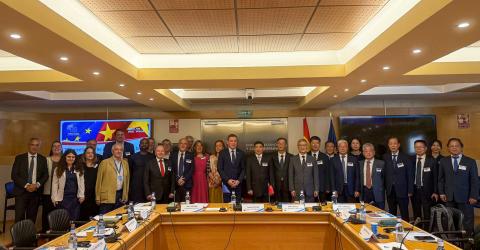
The European Economic and Social Committee (EESC) and the China Economic and Social Council (CESC) convened for the 20th EU-China Round Table, hosted in Madrid over two half-day sessions in the premises of the Spanish ESC. The mission opened with a preparatory encounter between EESC President Oliver Röpke and Chinese ESC Vice-President Shu Qiming.
Held in the context of the 50th anniversary of EU-China diplomatic relations, the Round Table reaffirmed the essential role of civil society in global cooperation. The first working session, chaired by President Röpke, addressed global infrastructure gaps through the lens of the EU’s Global Gateway and China’s Belt and Road Initiative. The EESC rapporteurs Stefano Palmieri and Jacek Krawczyk presented the European perspective, while CESC rapporteur Zhang Yuyan outlined China’s approach.
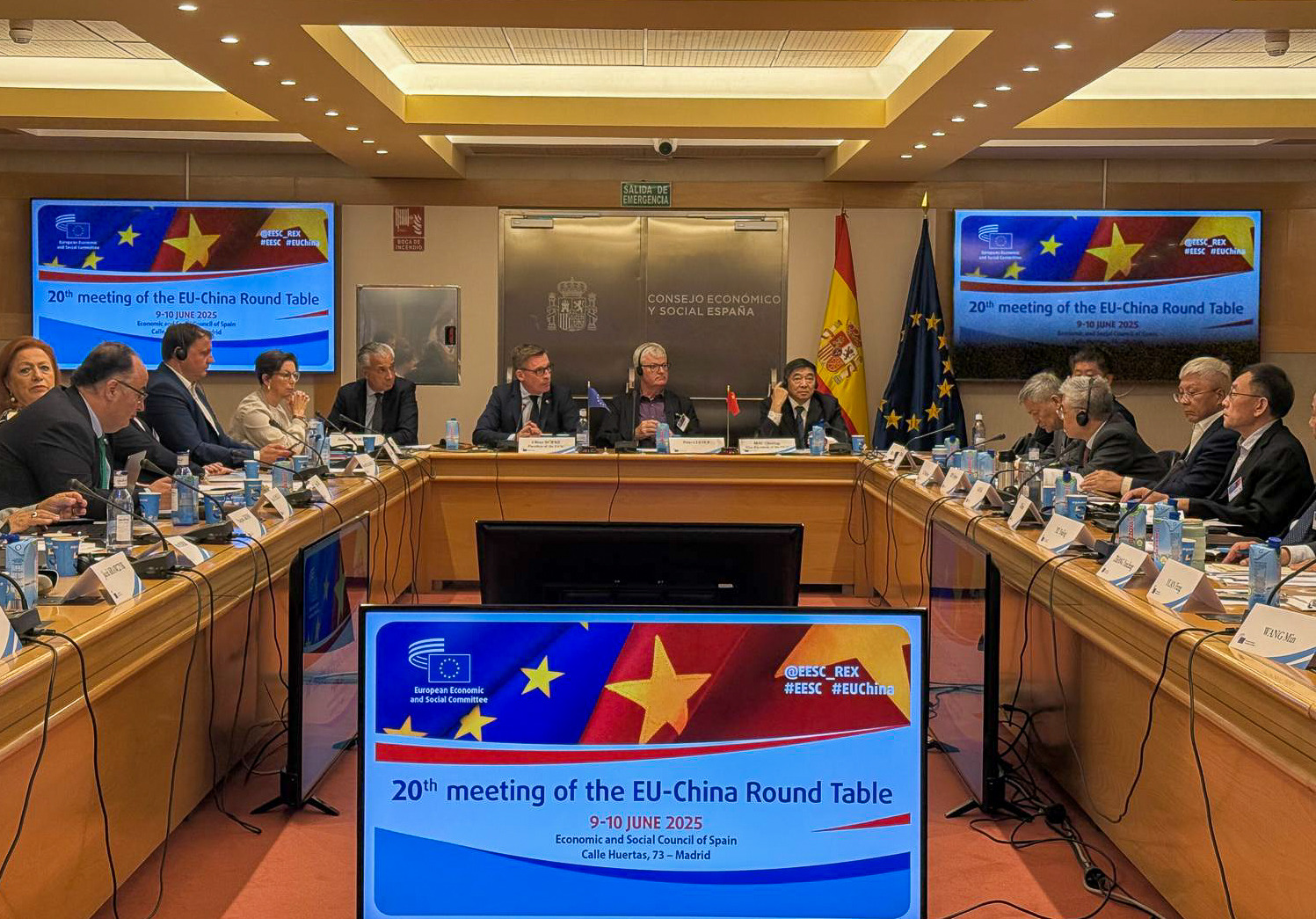
The second session, chaired by CESC Vice-President Shu Qiming, focused on climate finance and action ahead of COP30 in Bélem. EESC rapporteur Antje Gerstein and CESC rapporteur Piao Shilong led discussions on enhancing EU-China cooperation to meet Paris Agreement goals, emphasizing the urgency of trilateral engagement with Global South partners.
President Röpke highlighted the added value of people-to-people dialogue, especially at a time of complex geopolitical challenges. “Keeping this dialogue alive and thriving through regular meetings and meaningful discussions remains central to EU-China relations, as these exchanges contribute to a stronger, more resilient bilateral relationship,” he stated. He underscored the EESC’s continued commitment to open dialogue, mutual respect, and shared global responsibilities.
The meeting also marked a milestone in trilateral cooperation with the African Union Economic, Social and Cultural Council (AU ECOSOCC), with a first-time participation of a senior representative in the discussions. At this occasion, Mr. Kyeretwie Osei presented the African point of view on connectivity and climate finance. Observers from the Spanish ESC and the Cátedra China Foundation also joined, opening new paths for future cooperation.

With over 18 years of exchange, the EU-China Round Table remains a vital platform for civil society engagement, addressing global challenges through shared values, sustainability, and dialogue.
Recommended for you
Współtworzenie usług publicznych w sektorze opieki zdrowotnej przyczyni się do silniejszej demokracji uczestniczącej w UE
News
Podczas wydarzenia zorganizowanego przez Europejski Komitet Ekonomiczno-Społeczny (EKES) i Uniwersytet w Debreczynie podkreślono kluczowe znaczenie współtworzenia usług świadczonych w interesie…
Zorganizowane społeczeństwo obywatelskie UE nie zostawi Ukrainy
News
Europejski Komitet Ekonomiczno-Społeczny (EKES) zorganizował 19 lipca konferencję wysokiego szczebla nt. pomocy dla Ukrainy i jej odbudowy. Podczas tego wydarzenia zobowiązał się w pełni i na…
Europejski Komitet Ekonomiczno-Społeczny w Gdańsku. - Wolontariusze potrzebują rządowego wsparcia
News
O tendencjach w rozwoju wolontariatu w Unii Europejskiej, o nowych formach wolontariatu, ale też o wsparciu organów publicznych dla organizacji i wolontariuszy i jego roli gospodarczej - o tym, i nie…
Nowy europejski Bauhaus niesie wszechstronne korzyści dla przyszłości Europy
News
Uczestnicy seminarium internetowego zorganizowanego przez Europejski Komitet Ekonomiczno-Społeczny (EKES) opowiedzieli się za tym, by nowy europejski Bauhaus służył obywatelom Europy i pomagał w…
Instrumentalizacja migrantów i ukraiński kryzys uchodźczy wymagają ponownego namysłu nad polityką migracyjną
News
Finansowana przez państwo instrumentalizacja migrantów w celu destabilizacji UE oraz wojna w Ukrainie, która doprowadziła do niespotykanego dotąd napływu uchodźców, sprawiają, że niezbędny staje się…