
European Economic
and Social Committee
A stronger Europe needs a stronger cohesion policy, said President Röpke during the visit to Budapest

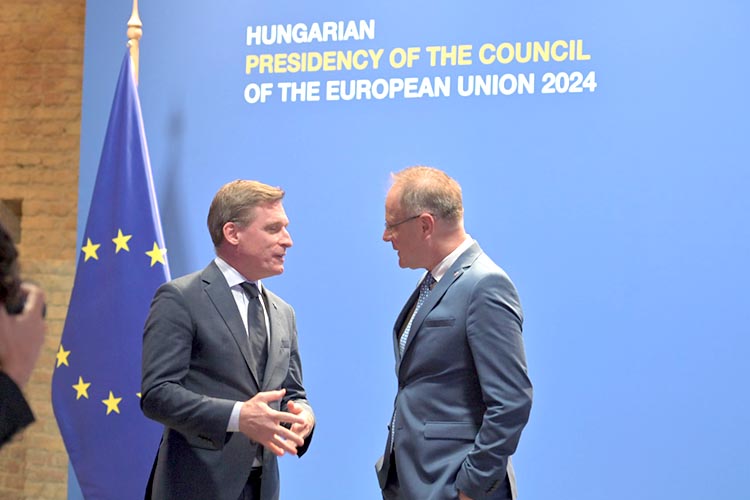
On 11 June, the EESC held its extraordinary Bureau meeting in Budapest, ahead of the start of the Hungarian Presidency of the EU next month. Opening the conference, EESC President Oliver Röpke discussed the importance of the EU's cohesion policy, which is among the priorities of the Hungarian Presidency.
Speaking alongside Hungarian Minister for Regional Development Tibor Navracsics, President Röpke said that the EU's cohesion policy needs new momentum, as it could reinforce people confidence in the European project. He also highlighted that the cohesion funding can be an important tool to shape the future of the EU and prepare for the next rounds of EU enlargements. The EESC has actively participated in discussions around the future of cohesion policy, recently welcoming the European Commission's 9th Cohesion Report and calling for a greater involvement of social partners and civil society in this debate.
President Röpke has also held a meeting with Hungarian Minister of EU Affairs János Bóka, during which he discussed the priorities of the Hungarian Presidency and the areas of the potential closer cooperation. In this context, the EESC has already received a request from the Hungarian Presidency for a number of exploratory opinions, including EU competitiveness, sustainable agriculture, the enlargement progress and demographic challenges. Minister Bóka then joined the EESC Members for the extraordinary Bureau meeting to further discuss the upcoming work of the Hungarian Presidency.
During his visit to Budapest, President Röpke met with local civil society organisations to discuss their work on issues such as youth, equality, and LGBT rights.

Recommended for you
Współtworzenie usług publicznych w sektorze opieki zdrowotnej przyczyni się do silniejszej demokracji uczestniczącej w UE
News
Podczas wydarzenia zorganizowanego przez Europejski Komitet Ekonomiczno-Społeczny (EKES) i Uniwersytet w Debreczynie podkreślono kluczowe znaczenie współtworzenia usług świadczonych w interesie…
Zorganizowane społeczeństwo obywatelskie UE nie zostawi Ukrainy
News
Europejski Komitet Ekonomiczno-Społeczny (EKES) zorganizował 19 lipca konferencję wysokiego szczebla nt. pomocy dla Ukrainy i jej odbudowy. Podczas tego wydarzenia zobowiązał się w pełni i na…
Europejski Komitet Ekonomiczno-Społeczny w Gdańsku. - Wolontariusze potrzebują rządowego wsparcia
News
O tendencjach w rozwoju wolontariatu w Unii Europejskiej, o nowych formach wolontariatu, ale też o wsparciu organów publicznych dla organizacji i wolontariuszy i jego roli gospodarczej - o tym, i nie…
Nowy europejski Bauhaus niesie wszechstronne korzyści dla przyszłości Europy
News
Uczestnicy seminarium internetowego zorganizowanego przez Europejski Komitet Ekonomiczno-Społeczny (EKES) opowiedzieli się za tym, by nowy europejski Bauhaus służył obywatelom Europy i pomagał w…
Instrumentalizacja migrantów i ukraiński kryzys uchodźczy wymagają ponownego namysłu nad polityką migracyjną
News
Finansowana przez państwo instrumentalizacja migrantów w celu destabilizacji UE oraz wojna w Ukrainie, która doprowadziła do niespotykanego dotąd napływu uchodźców, sprawiają, że niezbędny staje się…