
European Economic
and Social Committee
Europe's livestock strategy a good starting point, EESC notes
Committee welcomes Commission's strategy but calls for stronger funding, mandatory labelling and strengthening competitiveness for Europe's livestock farmers.
The European Economic and Social Committee (EESC) has broadly welcomed the European Commission's new Vision for Agriculture and Food and its forthcoming livestock strategy, but says Brussels must go significantly further if it wants Europe's livestock sector to remain competitive, sustainable and resilient. While supporting the Commission's overall direction, the Committee argues that the current proposals leave important gaps on financing, trade, labelling and support for farmers.
In a new opinion, the EESC sets out a more ambitious roadmap that places livestock farmers at the centre of Europe's food security, climate ambitions and rural economy.
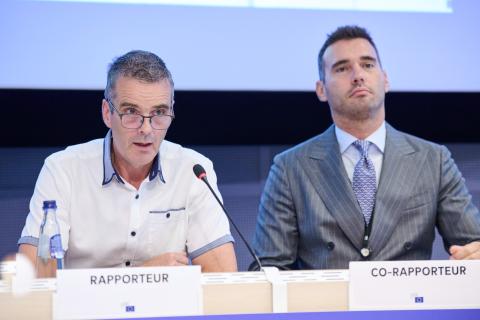
" Europe cannot build a sustainable food system without its livestock farmers. Our future livestock strategy must empower farmers to produce sustainably, remain competitive and uphold the world's highest standards of animal welfare. We welcome the Commission's recognition that biogenic methane requires a science-based approach, as well as its commitment to harmonised metrics and monitoring tools that better capture the climate efforts undertaken at farm level. Supporting livestock farming is not just about agriculture, it is about Europe's food security, strategic autonomy and the vitality of our rural communities, said Joe Healy the rapporteur of the opinion.
At the heart of the opinion is a call for a positive livestock strategy built on three equal pillars: sustainability, competitiveness and animal welfare. The EESC argues that reducing livestock production in Europe as is happening at the moment would simply shift production and lead to a significant increase in emissions to countries with lower environmental and welfare standards. This point is backed up by the Commissions JRC in their ‘Scenar 2040’ report from October 2025
“We must promote Europe´s high-performing livestock sector. Europe's livestock strategy needs dedicated financing to translate the positive narrative into tangible action on the ground. If we ask Europe's farmers to lead the transition, we must give them the tools to succeed and increase their productivity," said Florian Dalstein, the co-rapporteur.
Where the EESC goes further
Although the Commission recognises livestock as a strategic sector, the Committee proposes several measures that extend well beyond the Commission's current plans.
Perhaps the clearest difference concerns financing. While the Commission says it will explore a possible financial instrument for livestock, the EESC wants a dedicated EU Livestock Fund, established outside the Common Agricultural Policy (CAP), to finance investment and the sector's transition.
The Committee is also considerably more ambitious on the CAP itself. It calls for restoring the CAP budget to 0.5% of EU GDP, maintaining its two-pillar structure and index-linking both the budget and direct payments to preserve farmers' purchasing power. The Commission, by contrast, refers to the future CAP as the main support mechanism but proposes neither a specific budget level nor index-linking.
On trade and consumer information, the EESC advocates mandatory EU/non-EU origin labelling for all animal products and wants policymakers to explore labels indicating farming conditions such as cage-free or open-air production. The Commission supports strengthening the visibility of EU origin through marketing standards but stops short of proposing new mandatory origin labelling rules.
The Committee also adopts a firmer position on animal welfare. While both institutions support helping farmers adapt to higher welfare and environmental standards, the EESC explicitly calls for adequate funding, realistic transition periods and policies capable of delivering measurable improvements.
Research and innovation is another area where the Committee seeks greater ambition. It proposes a dedicated livestock research programme within both the European Competitiveness Fund and Horizon Europe, focusing on precision livestock farming, digital technologies, genomics and renewable energy on farms. The Commission highlights innovation as important but does not propose a dedicated programme.
The opinion also gives stronger backing to extensive, regenerative, agroforestry and organic livestock systems, arguing that these production models deserve targeted support because of their contribution to biodiversity, soil health and consumer expectations. The Commission recognises their value but does not specifically recommend dedicated support measures.
International trade also features prominently. the EESC proposes a dedicated animal protein export strategy aimed at expanding market access while promoting Europe's high sustainability standards abroad.
Finally, the Committee places greater emphasis on the social dimension of livestock farming. Alongside education and training, it highlights livestock's role in social farming, rural integration and community resilience—elements that receive far less attention in the Commission's strategy.
Beyond these differences, the EESC reiterates that equivalence of standards should become a non-negotiable principle in all future EU trade agreements, ensuring imported products meet the same environmental, animal welfare and social requirements imposed on European farmers.
For the Committee, Europe's livestock policy should not be driven by contraction but by investment.
Its message is clear: if the European Union wants to strengthen food security, maintain vibrant rural communities and meet its climate objectives, livestock farmers must be treated as partners in the transition—and given the financial and policy tools to succeed.
The committee did acknowledge and welcome the Commissions recognition of the Biogenic nature of Methane emissions, its short-term cycle and their commitment to developing harmonised metrics and monitoring tools that better reflect measures implemented at farm level. (ks)