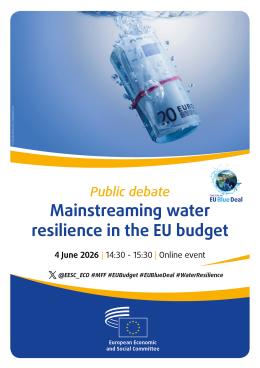
Mainstreaming Water Resilience in the EU Budget is a timely discussion on securing Europe’s water future. Discover how smarter EU investments can strengthen water resilience, sustainability, and preparedness, and how we should shape tomorrow’s funding priorities across programmes in the context of the EU´s next Multiannual Financial Framework.
The Commission is proposing amendments to three EU regulations to ensure that EU funds can be quickly mobilised in support of post-disaster recovery.
The amendments concern theRegulations governing the European Regional Development Fund (ERDF) and the Cohesion Fund (CF), and the European Social FundPlus (ESF+), for the 2021-2027 programming period.
These proposals come as a direct response to the floods affecting Central and Eastern European countries and wildfires in Portugal in September 2024 and include injecting liquidity with increased pre- and co-financing under Cohesion Policy.
In response to the European Commission's proposals for a comprehensive forest monitoring framework, the European Economic and Social Committee (EESC) has issued an opinion which includes cautious welcomes, recommendations, and calls for further review. The EESC emphasizes the need for sustainability, inclusivity, and respect for property rights in the proposed forest data system, while also urging attention to technical limitations and judicial considerations.
An interview with Florian MARIN, member of the NAT section of the European Economic and Social Committee (EESC) from the workers' group (GR-II) since 2020. He represents the Federation of Free Trade Union in Romania, of which he's the president. His work focuses, among others, on topics such as rural and sustainable development, sustainable food systems, circular economy and deforestation.
The EESC is organising an online public hearing to gather stakeholders' and civil society's views on the new EU Forest Strategy for 2030, which will feed into the preparation of the EESC opinion on this topic.