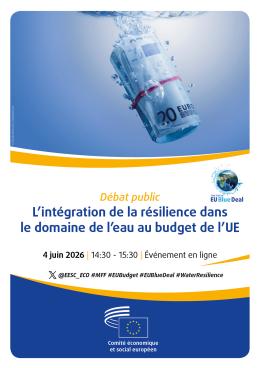
L'intégration de la résilience dans le domaine de l'eau au budget de l'UE est un sujet d’actualité pour garantir l’avenir de l’eau en Europe. Découvrez comment des investissements européens plus judicieux peuvent renforcer la résilience, la durabilité et la préparation en matière d’eau, et comment définir les priorités de financement des programmes de demain dans le cadre du prochain cadre financier pluriannuel de l’UE.
La Commission propose de modifier trois règlements de l’UE afin de garantir que les fonds de l’UE puissent être rapidement mobilisés pour soutenir la reprise après une catastrophe.
Les modifications concernent les règlements régissant le Fonds européen de développement régional (FEDER) et le Fonds de cohésion (FC), ainsi que le Fonds social européen plus (FSE+), pour la période de programmation 2021-2027.
Ces propositions constituent une réponse directe aux inondations qui ont touché les pays d’Europe centrale et orientale et aux incendies de forêt au Portugal en septembre 2024 et comprennent l’injection de liquidités avec un préfinancement et un cofinancement accrus au titre de la politique de cohésion.
In response to the European Commission's proposals for a comprehensive forest monitoring framework, the European Economic and Social Committee (EESC) has issued an opinion which includes cautious welcomes, recommendations, and calls for further review. The EESC emphasizes the need for sustainability, inclusivity, and respect for property rights in the proposed forest data system, while also urging attention to technical limitations and judicial considerations.
Download — Avis du CESE: Une stratégie globale en faveur de la diversité biologique à la COP 16: rassembler tous les secteurs autour d’un objectif commun
An interview with Florian MARIN, member of the NAT section of the European Economic and Social Committee (EESC) from the workers' group (GR-II) since 2020. He represents the Federation of Free Trade Union in Romania, of which he's the president. His work focuses, among others, on topics such as rural and sustainable development, sustainable food systems, circular economy and deforestation.
Le CESE organise une audition publique en ligne pour recueillir les points de vue des parties prenantes et de la société civile sur la nouvelle stratégie de l’Union européenne pour les forêts qui alimenteront la préparation de l'avis du CESE sur ce sujet.