Kummerċ internazzjonali

This page is also available in:

International trade is governed by a complex mixture of global rules agreed under World Trade Organization and bilateral and multilateral agreements. The free trade agreements are having a growing impact on citizens' rights. Under the Lisbon Treaty, EU trade policy must be conducted within the framework of the principles and objectives of the Union’s external action, including promotion of the rule of law, human rights and sustainable development.

We believe that this trend should be a guiding principle in EU trade negotiations and in trade relations. The fact that we at the EESC reconcile the positions and views of business, workers, professionals, farmers, consumers and other important stakeholders contributes real added value. We are in a position to efficiently relay the opinions of civil society and interest groups to international policy-makers both during negotiations and in the implementation of trade agreements. We have set up a Follow-up Committee on International trade to ensure that civil society has a say in the shaping of EU trade policy. We are also managing the Domestic Advisory groups set up under the trade and sustainable development chapters of the EU "new generation" trade agreements. These groups, composed of civil society representatives (from inside and outside the EESC) are responsible for identifying trade and sustainable development-related problems in the implementation of a trade agreement.

  • The ongoing COVID-19 crisis has shown the fragility of global supply chains. It has also exposed the vulnerability of workers and the adverse social, health and safety impacts of business operations in today’s supply chains. ...

  • -

    Domestic Advisory Groups of the EU and three Andean countries – Colombia, Peru and Ecuador – held their 11th Joint Meeting and Workshop on 2-3 December 2025 in Lima. The discussions focused on future priorities for cooperation, the role of civil society in monitoring and advancing Trade and Sustainable Development commitments, and key thematic areas such as labour rights, environmental challenges, and EU supply-chain sustainability regulations.

  • -

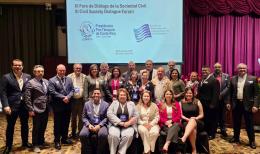
    Joint events of the Domestic Advisory Groups of the EU and six Central American countries were hosted by Costa Rica in San José, on 24-26 June 2025.

  • On 21 May 2025 the EESC will hold an online event on the link between trade policy and sustainability, with a particular focus on agri-food systems. Through panel discussions, EESC members, representatives of the European Commission and of civil society will exchange views on the role of reciprocity in achieving a fair green transition. 

  • The 12th meeting of the EU Domestic Advisory Group (DAG) under the EU-Japan Economic Partnership Agreement (EPA) took place on 10 April, 2025 at the EESC.

  • -

    10th Joint Events of the EU DAG and representatives from the domestic mechanisms of Colombia, Peru and Ecuador, and Civil Society Public Session

    Domestic Advisory Groups of the EU and three Andean countries – Colombia, Peru and Ecuador – held their virtual Joint Meeting on 4-5 November 2024.

  • New mandate, new challenge - reaffirming TSD amid economic security ambitions

    The third edition of the EESC Civil Society Forum on Trade and Sustainable Development (TSD) took place on Thursday, 5 December, from 13:45 to 17:30 at the EESC premises in Brussels. Under the theme "New mandate, new challenge: reaffirming TSD amid economic security ambitions," this year's Forum focused on ensuring that the EU's economic security agenda is consistent with and delivers for TSD. As we welcome a new EU Commission, this is the moment to influence policy direction and ensure that trade policy fosters resilience and security alongside long-term development and social justice for all partners. 

  • -

    Domestic Advisory Groups of the EU and six Central American countries held their Joint Meeting in Brussels on 17-18 June. The DAGs took part in a Workshop focused on two pertinent topics: Corporative Sustainability Due Diligence and the EU Deforestation Directive. During the Joint Meeting the DAGs discussed their role and functioning, in particular in view of the full application of the Association Agreement. The delegates exchanged good practices and debated the consequences of the full application of the AA for civil society sensu largo and on the work of the DAGs. Important part of the discussion was dedicated to the space for democracy and the role of civil society and advisory groups in strengthening democracy and rights.

    The DAGs adopted the Joint Declaration.

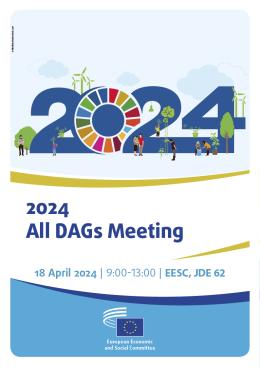
  • The 4th annual All DAGs meeting took place on Monday 18 April 2024 09:00-13:00 at the EESC premises in JDE62.
    This was the first All DAGs meeting of this DAG mandate which welcomed the newer DAG Members, as well as more experienced ones. It was a unique opportunity to gather all EU DAG Members and EU institutions as one TSD community, to openly exchange ideas, challenges, and aspirations. The meeting featured, among others, CTEO Denis Redonnet and DDG Maria Martin-Prat, DG Trade.

  • -

    The EU-Japan DAG hosted a workshop: "Promoting human rights and environmental due diligence together" on 9 April 2024 following a Joint Dialogue with Civil Society in Tokyo on 8 April. The workshop's objective was to foster dialogue between EU and Japan civil society representatives, focusing on best practices and a solution-oriented approach in an area of importance to the implementation of the TSD-chapter of the EU-Japan EPA. Human rights and environmental due diligence are topics of common interest, as the EU and Japan share values and want to secure resilient supply chains so as to do business in a sustainable way.