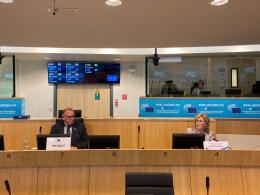
Just before the summer break, Commissioner Mairead McGuinness joined an extraordinary meeting of the Diversity Europe Group of the EESC to debate the role of finance and banking in Europe's recovery.
The European Economic and Social Committee (EESC) welcomes the Commission's new Action Plan on non-performing loans, but believes that it lacks new proposals fit for COVID-19 times, leaving Europe to face an extraordinary time with rules written for ordinary times.
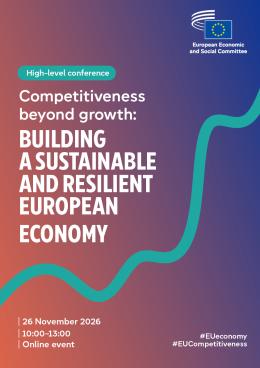
As Europe seeks to strengthen its competitiveness in an increasingly fragmented global economy, the challenge is not only to boost productivity and innovation, but also to preserve the foundations of its social market economy. This high-level conference will examine how the EU can mobilise savings and investment, maintain sustainable public finances, and deepen Economic and Monetary Union to support long-term growth, resilience and convergence.
We will discuss on the views of the European Parliament, the progress in the Strategy of the Commission, and learn from the presentation of impactful initiatives by a financial sector association and a trade union. A debate with members and remote participants will follow.
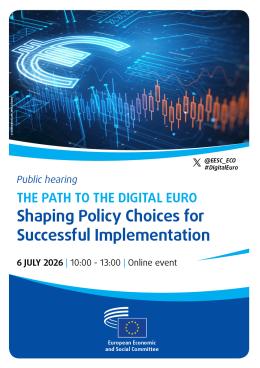
In the context of the work on the own-initiative opinion on the introduction of the digital euro, the ECO section decided to organise a public hearing bringing together experts from European and international institutions and various organised civil society.
This public hearing will gather policymakers and civil society stakeholders to discuss on how public banks can better support EU industrial policy, innovation, the scale-up of EU businesses, and, ultimately, economic growth.
This public hearing will bring together policymakers and civil society stakeholders to discuss on existing initiatives, the role that civil society should play, and what policy actions are necessary to untap their potential in this regard.
The legislative package proposed by the European Commission are likely to affect the availability of financial instruments for EU citizens, the returns of their savings and national policies on supplementary pensions. This event will gather institutions and civil society stakeholders.
This debate will bring representatives from public actors and civil society to discuss on their views on the Commission proposal to further integrate capital markets and how to make it fit for purpose.
The EESC organises a public hearing on Financial literacy and education for Europeans. It will gather together institutions, industry and civil society stakeholders, and will discuss desirable policy actions and share good practices along the EU.