This public hearing will gather policymakers and civil society stakeholders to discuss on how public banks can better support EU industrial policy, innovation, the scale-up of EU businesses, and, ultimately, economic growth.
This public hearing will bring together policymakers and civil society stakeholders to discuss on existing initiatives, the role that civil society should play, and what policy actions are necessary to untap their potential in this regard.
The legislative package proposed by the European Commission are likely to affect the availability of financial instruments for EU citizens, the returns of their savings and national policies on supplementary pensions. This event will gather institutions and civil society stakeholders.
This debate will bring representatives from public actors and civil society to discuss on their views on the Commission proposal to further integrate capital markets and how to make it fit for purpose.
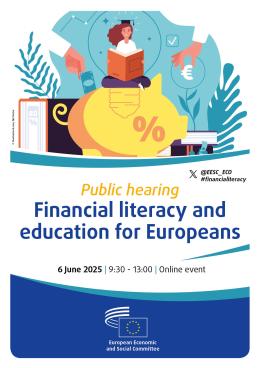
The EESC organises a public hearing on Financial literacy and education for Europeans. It will gather together institutions, industry and civil society stakeholders, and will discuss desirable policy actions and share good practices along the EU.
On 11 February, the European Commission published its 2025 work programme. Several initiatives in the work programme – initiatives to enhance competitiveness through the promotion of reforms and investments, both private and public, the new the Savings and Investment Union, as well as the next Multiannual Financial Framework, just to name a few – fall in the remit of the Section for Economic and Monetary Union and Economic and Social Cohesion (ECO) of the European Economic and Social Committee (EESC). We organise this debate to discuss with representatives of the Commission and the members of the EESC the conditions and actions needed for the EU and its Member States to successfully implement what is outlined in the Commission and achieve the shared goals of the Union.
Public debate with Fabian Zuleeg, Chief Executive and Chief Economist, European Policy Centre (EPC)
Event type
Debate
Location
Online event
Belgium
Public debate on Reforms for a more resilient economy for all: the new EU legislature with Fabian Zuleeg, Chief Executive and Chief Economist, European Policy Centre (EPC)
The Capital Markets Union (CMU) is an initiative that was launched in 2014 with the aim of creating a single market for capital in the EU. Today, despite concerted efforts towards more integrated capital markets, such as the 2015 and 2020 Action Plans, the CMU remains incomplete. Yet, recent developments offer hope for renewed momentum. The statement of the Eurogroup in inclusive format on the future of the CMU, and the report "Much more than a market", by Enrico Letta, outline fresh proposals on how to further integrate financial markets in the EU and stimulate investment. Against this backdrop, this public debate will convene institutional actors and civil society stakeholders to take stock of current developments and discuss policy solutions for the upcoming parliamentary term.
The EESC is organising this public hearing to discuss the strengths and weaknesses of the legislative framework on securitisation, as well as risks related to securitisation and possible policy solutions.