
European Economic
and Social Committee
European Commission's 2024 Work Programme must focus on economic and social aspects
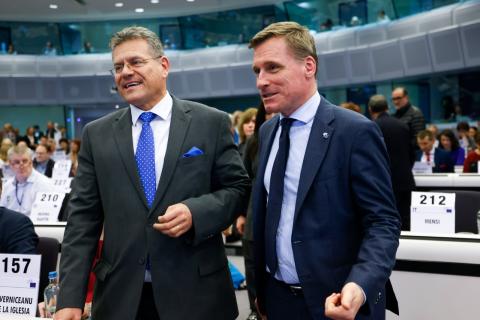
At the February plenary session, the European Economic and Social Committee (EESC) pointed out that the key factors for recovering from the recent crises and delivering a more resilient EU were sustainable growth, social convergence, a favourable business environment and better employment conditions.
The European Commission's top priority for 2024 will be ensuring that Europe recovers, with due regard for the economic and social aspects. The main objective will be to mitigate the harmful impact of the war in Ukraine and the resulting energy crisis.
During the plenary session debate on 14 February, EESC president Oliver Röpke praised the Commission's 2024 work programme: This programme puts a strong focus on simplifying rules for citizens and businesses across the European Union. I personally am grateful that those measures come without lowering social, safety, consumer protection, environmental or economic standards. We are aware that Europe is facing an ever-increasing number of unforeseen challenges.
Referring to a time of unprecedented challenges but also unprecedented opportunities,
Maroš Šefčovič, European Commission Executive Vice-President for the European Green Deal, Interinstitutional Relations and Foresight, stressed the Commission's determination to reduce the administrative burden on the EU's people and companies: It is crucial to make sure that our businesses remain competitive in the current global and economic context, particularly our small and medium-sized enterprises. That is why we are continuing our work to reduce the burdens arising from report requirements by 25% without undermining our policy objectives.
The Commission's 2024 work programme outlines 41 proposals to simplify and rationalise reporting requirements which together will bring an estimated 3.6 billion euros in savings. In 2024, we are also continuing our efforts to further the green transition and properly implement the Green Deal, while preserving the competitiveness of our industry and ensuring a transition which is socially fair, just and inclusive,
Mr Šefčovič added, mentioning the need to work closely with and talk to all stakeholders, including farmers.
Against this backdrop, the EESC president pointed out that the Committee's opinions had highlighted a number of factors that were key for recovering from the crises and making the EU more resilient. These included sustainable growth, social convergence, a favourable business environment, better employment conditions and focusing on social and economic upward convergence, leaving no one behind.
The Executive Vice-President was pleased to note that the Committee had worked on important initiatives such as the enlargement candidate country members (the EESC is the first EU institution to involve EU candidate countries in its work), the EU Youth Test (the Committee thinks that the youth perspective should be taken into account in every policy area), and the EU Blue Deal (the EESC's call to build a comprehensive approach to European water policies).
During the debate with EESC members, Stefano Mallia, president of the EESC's Employers Group, also focused on the EU's competitiveness, saying that European companies were struggling to meet the objectives of the green transition and that an assessment was needed to check whether they were still realistic and feasible.
On behalf of the EESC's Workers Group, the president of the EESC's Social Affairs Section, Cinzia Del Rio said that the green and digital transition must be flanked by measures to promote social sustainability. Social security must go hand in hand with the economy, and the economic agenda could never overlook the social dimension of investments and reforms. A solid social dimension was also an effective answer to populist rhetoric.
Lastly, Séamus Boland, president of the Civil Society Organisations Group, questioned whether the Commission's priorities were in line with those of citizens, as reflected in a recent Eurobarometer survey. He underlined that non-alignment was dangerous, especially with populism on the rise, and that the EU had to connect with and reach out to Europeans in every possible way to hear what they had to say and stem the disconnect between institutions and people.
Downloads
-
European Commission's 2024 Work Programme must focus on economic and social aspects
Recommended for you
Decision repealing Directive 89/629/EEC
Opinion
DOKUMENTO ESMĖ EESRK: remdamasis tuo, kad pasiūlymas yra visiškai priimtinas ir kad dėl jo neturi pastabų, nusprendė pateikti palankią nuomonę dėl siūlomo dokumento.
EESRK: ES turi atkreipti dėmesį į socialinį tvarumą
News
Europos ekonomikos ir socialinių reikalų komitetas (EESRK) paragino Europos Komisiją paskelbti ilgai lauktą ataskaitą, kurioje būtų įvertinta galimybė išplėsti ES tvarumo taksonomijos reglamento…
RePowerEU Plan
Opinion
DOKUMENTO ESMĖ EESRK mano, kad Europos Komisijos planas „REPowerEU“ yra žingsnis teisinga linkme siekiant, kad ES taptų nepriklausoma nuo Rusijos dujų ir naftos tiekimo; pabrėžia, kad daugelio…
Migrantų instrumentalizavimas ir Ukrainos pabėgėlių krizė verčia persvarstyti migracijos politiką
News
Dėl valstybės remiamo migrantų instrumentalizavimo, kuriuo siekiama destabilizuoti ES, ir dabartinio karo Ukrainoje, sukėlusio precedento neturintį pabėgėlių antplūdį, reikia peržiūrėti Europos…
Individual and collective energy self-consumption as a factor in the fight for the green and energy transition, and for economic and social balance
Opinion
Individualus ir kolektyvinis pasigamintos energijos vartojimas kaip žaliosios ir energetikos pertvarkos ir ekonominės ir socialinės pusiausvyros veiksnys Dokumento esmė EESRK mano, kad vietos ir…