This document presents the five priorities of the EESC Employers’ Group and the policy actions for policymakers to improve the business environment, and thereby the EU’s competitiveness and conditions for creating prosperity for citizens.
In this overview the European Economic and Social Committee (EESC) shares its opinions on the European Commission’s proposals for the Multiannual Financial Framework (MFF) 2028-2034, bringing together the perspectives of organised civil society on the future direction of the EU budget.
Public debate in the ECO Section on the "The international role of the euro: A European safe asset for a new geopolitical era?". This public debate will explore the opportunities and challenges associated with strengthening the international role of the euro and discuss the economic, financial and geopolitical arguments for and against the creation of a European safe asset.
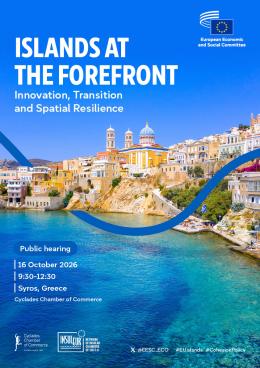
As part of the preparation of the EESC opinion on an EU Strategy for Islands, the European Economic and Social Committee, in cooperation with INSULEUR, will hold a public hearing in Syros, at the heart of the Cyclades. The hearing aims to bring together local and regional authorities, organised civil society, businesses, academia and citizens to exchange views on both the challenges and the untapped opportunities facing Europe's islands.
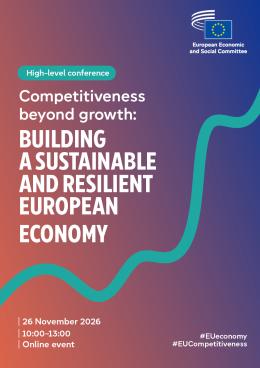
As Europe seeks to strengthen its competitiveness in an increasingly fragmented global economy, the challenge is not only to boost productivity and innovation, but also to preserve the foundations of its social market economy. This high-level conference will examine how the EU can mobilise savings and investment, maintain sustainable public finances, and deepen Economic and Monetary Union to support long-term growth, resilience and convergence.
rue Belliard 101, Jacques Delors building, room JDE 63, 9:30-11:00
Brussels
Belgium
EESC, room JDE 63, 9:30-11:00
The policy debate brings together stakeholders to assess how National and Regional and Partnership Plans will work in practice. In a workshop setting connected to the European Economic and Social Committee, participants from civil society, social partners and institutions will exchange perspectives on transparency, inclusiveness and impact. The discussion aims to highlight gaps, share best practices and strengthen the role of organised civil society in shaping and monitoring the implementation of NRPPs in the EU.