
European Economic
and Social Committee
EESC urges bold action to strengthen the EU’s economy and the European Semester
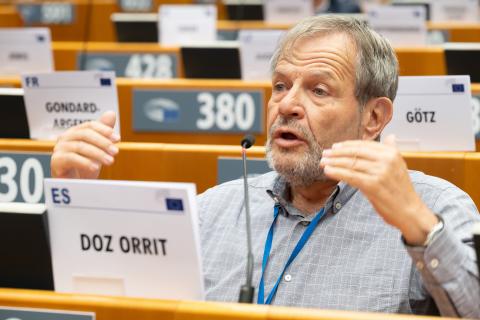
The European Economic and Social Committee (EESC) has adopted two important opinions in plenary outlining the priorities for the euro area economy and the European Semester in 2025. The EESC calls for urgent and coordinated measures to boost investment, competitiveness, social cohesion and strategic autonomy, while responding to global economic and geopolitical challenges. One opinion, drafted by rapporteur Juraj Sipko, focuses on additional considerations on the euro area economic policy 2025. The other, led by rapporteur Javier Doz Orrit, puts forward recommendations for additional considerations on the way forward for the European Semester 2025.
The EU’s economic growth has been weak over the last five years, especially compared to the US and China. Inflation has stabilised and unemployment remains relatively low, but productivity is lagging and living standards have suffered. The EESC highlights the risks posed by global trade tensions, particularly the ongoing US trade war, and stresses that the EU must be prepared for unpredictable developments in international markets.
Investment and competitiveness are key
Both sets of recommendations emphasise the need for higher public and private investment, particularly in strategic sectors such as clean technologies, digital innovation, and research and development. Simplifying administrative procedures, modernising financing tools and fully exploiting the potential of the single market, including in services, are critical to strengthening competitiveness. The EESC supports EU initiatives like the Single Market Strategy, the Clean Industrial Deal and the Competitiveness Compass, but calls for faster implementation and practical action plans.
Green transition and sustainability
The Committee underlines that competitiveness must go hand in hand with sustainability. Public investments are needed to meet climate targets, promote the circular economy and support the green transition while maintaining social and environmental standards. Reforms to the EU Emissions Trading System and other mechanisms are recommended to ensure a stable, affordable and sustainable energy market.
Fiscal and monetary policy
The EESC calls for sustainable public finances while allowing targeted investments in strategic sectors. It supports the newly revised EU fiscal rules to create fiscal space for growth-enhancing projects, and it recommends a moderately expansionary monetary policy once inflation is under control, as well as strengthening the role of the euro as a global reserve currency. Measures include completing the Banking Union and Capital Markets Union, introducing the digital euro and using EU debt strategically to finance investment.
European Semester and investment priorities
The Committee stresses the importance of the European Semester and supports its focus on competitiveness and enhancing defence capabilities. It calls for stronger civil society involvement, for a permanent and structured involvement of the social partners and civil society organisations in the various stages of the European Semester process, and for attention to social criteria, including quality of life, housing and collective bargaining. The EESC also highlights the need to fully implement national recovery and resilience plans (NRRPs), to strengthen investment, to ensure the implementation of all Recovery and Resilience Facility (RRF) funds with the new targets and, if necessary, deploy unused funds for new investment programmes in European public goods. In addition, it points to the need to establish a European Fund for Strategic Investments, to strengthen the EIB’s lending capacity to expand InvestEU and to explore the possibility of using European Stability Mechanism funds.
Geopolitical context
Both opinions underline the impact of geopolitical instability, wars and global trade tensions on economic performance and investment decisions. The EESC calls for a coordinated EU approach to strategic autonomy in industrial, trade, security and defence policies. It stresses that Europe must defend democracy, human rights and the rules-based international order, while strengthening its defence capabilities and industrial base.
The EESC concludes that the EU and euro area must act decisively to close the investment gap, boost productivity and innovation, and reinforce resilience against external shocks. Coordinated efforts across all levels of governance are needed to ensure competitiveness, social fairness and sustainable growth. Without prompt action, the Committee warns, the EU risks falling further behind its global competitors, with long-term consequences for its economy and society.
Work organisation
Recommended for you
Toghadh Séamus Boland ina Uachtarán ar Choiste Eacnamaíoch agus Sóisialta na hEorpa, agus gheall sé go gcuirfear an tsochaí shibhialta i gcroílár na hEorpa
News
Toghadh Séamus Boland na hÉireann ar an 35ú Uachtarán ar Choiste Eacnamaíoch agus Sóisialta na hEorpa (CESE) le haghaidh an téarma oifige 2025-2028. Is urlabhra riamh anall é do phobail na tuaithe…
CESE, Uachtarántacht na hÉireann agus an fhís choiteann atá acu
News
I ndiaidh na díospóireachta a reáchtáladh le Comhaltaí CESE le linn sheisiún iomlánach mhí Iúil, níl aon dabht faoi ach go bhfuil clár Uachtaránacht reatha an Aontais ag freagairt go mór do na…
#YEYS2022: Ceist na bréagaisnéise pléite ag aos óg na hEorpa agus a dtuairimí ina leith curtha in iúl acu don Leas-Uachtarán Jourová
News
Chuir daltaí meánscoile ó gach cearn den Eoraip ocht gcinn de thograí nithiúla faoi bhráid Leas-Uachtarán an Choimisiúin Eorpaigh um Luachanna agus um Thrédhearcacht, Věra Jourová. Bhí páirt á…
#CivilsocietyforUkraine
News
Cáineann CESE ionradh Rialtas na Rúise ar an Úcráin, ionradh atá gan údar agus gan chúis Rún ó Choiste Eacnamaíoch agus Sóisialta na hEorpa (CESE) maidir leis an gcogadh san Úcráin agus an tionchar…
Eagrán speisialta de CESE info
News
Eagrán speisialta de CESE info atá dírithe ar an Úcráin. Is féidir scéal Tetyana Ogarkova a léamh, bean a chuala fuaim ionradh na Rúise ar dhúiseacht di an 24 Feabhra.