
European Economic
and Social Committee
EESC urges bold action to strengthen the EU’s economy and the European Semester
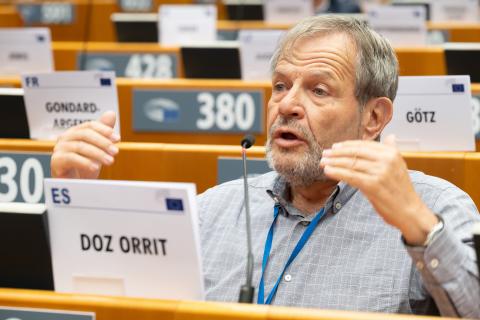
The European Economic and Social Committee (EESC) has adopted two important opinions in plenary outlining the priorities for the euro area economy and the European Semester in 2025. The EESC calls for urgent and coordinated measures to boost investment, competitiveness, social cohesion and strategic autonomy, while responding to global economic and geopolitical challenges. One opinion, drafted by rapporteur Juraj Sipko, focuses on additional considerations on the euro area economic policy 2025. The other, led by rapporteur Javier Doz Orrit, puts forward recommendations for additional considerations on the way forward for the European Semester 2025.
The EU’s economic growth has been weak over the last five years, especially compared to the US and China. Inflation has stabilised and unemployment remains relatively low, but productivity is lagging and living standards have suffered. The EESC highlights the risks posed by global trade tensions, particularly the ongoing US trade war, and stresses that the EU must be prepared for unpredictable developments in international markets.
Investment and competitiveness are key
Both sets of recommendations emphasise the need for higher public and private investment, particularly in strategic sectors such as clean technologies, digital innovation, and research and development. Simplifying administrative procedures, modernising financing tools and fully exploiting the potential of the single market, including in services, are critical to strengthening competitiveness. The EESC supports EU initiatives like the Single Market Strategy, the Clean Industrial Deal and the Competitiveness Compass, but calls for faster implementation and practical action plans.
Green transition and sustainability
The Committee underlines that competitiveness must go hand in hand with sustainability. Public investments are needed to meet climate targets, promote the circular economy and support the green transition while maintaining social and environmental standards. Reforms to the EU Emissions Trading System and other mechanisms are recommended to ensure a stable, affordable and sustainable energy market.
Fiscal and monetary policy
The EESC calls for sustainable public finances while allowing targeted investments in strategic sectors. It supports the newly revised EU fiscal rules to create fiscal space for growth-enhancing projects, and it recommends a moderately expansionary monetary policy once inflation is under control, as well as strengthening the role of the euro as a global reserve currency. Measures include completing the Banking Union and Capital Markets Union, introducing the digital euro and using EU debt strategically to finance investment.
European Semester and investment priorities
The Committee stresses the importance of the European Semester and supports its focus on competitiveness and enhancing defence capabilities. It calls for stronger civil society involvement, for a permanent and structured involvement of the social partners and civil society organisations in the various stages of the European Semester process, and for attention to social criteria, including quality of life, housing and collective bargaining. The EESC also highlights the need to fully implement national recovery and resilience plans (NRRPs), to strengthen investment, to ensure the implementation of all Recovery and Resilience Facility (RRF) funds with the new targets and, if necessary, deploy unused funds for new investment programmes in European public goods. In addition, it points to the need to establish a European Fund for Strategic Investments, to strengthen the EIB’s lending capacity to expand InvestEU and to explore the possibility of using European Stability Mechanism funds.
Geopolitical context
Both opinions underline the impact of geopolitical instability, wars and global trade tensions on economic performance and investment decisions. The EESC calls for a coordinated EU approach to strategic autonomy in industrial, trade, security and defence policies. It stresses that Europe must defend democracy, human rights and the rules-based international order, while strengthening its defence capabilities and industrial base.
The EESC concludes that the EU and euro area must act decisively to close the investment gap, boost productivity and innovation, and reinforce resilience against external shocks. Coordinated efforts across all levels of governance are needed to ensure competitiveness, social fairness and sustainable growth. Without prompt action, the Committee warns, the EU risks falling further behind its global competitors, with long-term consequences for its economy and society.
Work organisation
Recommended for you
Tetyana Ogarkova: "The day of victory will come but it will not bring normality back"
Agenda
On 24 February 2022, the lives of millions of Ukrainians were turned upside down. Now, when we say the word "victory", we expect that day to be the way things used to be. A normal day, a day of peace…
Lutte contre la précarité énergétique: garantir un approvisionnement énergétique abordable devrait figurer au premier rang des priorités politiques des pays de l’UE
News
Alors que le nombre de ménages qui sont dans l’incapacité de chauffer leur logement va vraisemblablement augmenter dans l’Union, avec une inflation annuelle de l’énergie qui dépasse 40 %, il y a…
Les zones rurales ont le potentiel pour produire davantage de résultats
News
Si l’attrait de la vie à la campagne s’est accru ces toutes dernières années, de nombreuses zones rurales de l’Union restent confrontées à un certain nombre de problèmes qui dissuadent les personnes…
Pour lutter contre le sans-abrisme, il faut une approche globale et une action collective
News
Le 7 octobre dernier, le Comité économique et social européen (CESE) a tenu une conférence sur le sans-abrisme et les moyens d’éradiquer ce phénomène d’ici à 2030, en appliquant le principe du…
Un rôle actif pour la société civile organisée est essentiel à la résilience de l’Union européenne
News
Le CESE a tenu un débat en session plénière sur l’importance croissante de la société civile organisée et des villes pour mettre l’Europe en capacité de faire face aux chocs asymétriques et aux…